Chinese aircraft maker to recruit foreign managers
http://www.iht.com/bin/printfriendly.php?id=20418758
The Associated Press
Wednesday, February 25, 2009
BEIJING: China's main state-owned aircraft maker says it will recruit its first executives from abroad — an unprecedented step for the secretive world of Chinese military contractors — amid efforts to create a commercial aerospace supplier to compete with Boeing Co. and Europe's Airbus.
Aviation Industry Corp. of China, which makes Beijing's fighter jets, is pushing ahead with aggressive business plans despite global financial turmoil. It got a 176 billion yuan ($26 billion) credit line from state banks in January to develop a 150-seat jetliner. It test-flew a smaller commercial jet in November and is building China's first helicopter factory.
AVIC is looking for vice presidents for 13 subsidiaries who have experience at multinational companies in marketing, research and production, said Ding Zhiyong, a company spokesman. He said most posts were in civilian areas such as helicopters and cargo planes but some were in defense, though he declined to give other details. The company says it plans to formally launch the recruiting efforts Thursday.
Efforts by Chinese companies to recruit executives with foreign experience usually are aimed at ethnic Chinese abroad. However, Ding said, "This recruitment is open to all around the globe."
Foreign skills should help AVIC, now run largely by soldiers and government officials, meet goals that include developing a jetliner by 2020, said Jon Grevatt, the Asia-Pacific defense industry correspondent for Jane's Information Group. He said non-Chinese citizens probably will be kept away from military technology.
"China has very ambitious plans for its commercial and military modernization and it was quite clear that the old AVIC wasn't working properly," Grevatt said. "Having real Western-style project managers in place who are used to driving through such enormous challenges as a large-scale jet airliner is what they are after."
AVIC adds to a growing list of Chinese companies that are hiring executives with experience abroad to fill gaps in skills and experience as they expand into global markets.
Personal computer maker Lenovo Group appointed an American CEO, William J. Amelio, who launched its effort to develop a global brand following its 2005 acquisition of IBM Corp.'s PC unit. Amelio stepped down in December after a three-year stint.
SAIC Motor Corp. hired Phil Murtaugh, formerly in charge of General Motors' China operations, as a vice president in 2006. He left the following year to become chief executive of Chrysler LLC's Asia operations.
The strongest demand is for managers with experience at marketing and research, where Chinese companies lag, said Thomas Zhou, a partner in Shanghai for DaCare Consulting, which finds foreign executives for companies in China.
"This is an easy and quick way they can bring in not only new ideas and innovation but also methodology — how to invent the stuff," Zhou said.
Zhou said DaCare places about 300 foreign executives a year in China at levels up to vice president. Most go to foreign-owned operations, but Zhou said the number placed with Chinese employers is expected to rise to 15 to 20 this year, up from single digits in 2008.
"The trend is picking up," he said.
The communist government created AVIC in November by merging its two biggest aerospace companies. It immediately announced initiatives in a sweeping array of areas ranging from jetliners to helicopters.
The company has the advantage that its home Chinese aviation market is one of the world's biggest and fastest-growing. Boeing has forecast Chinese carriers will need 3,400 new aircraft over the next two decades.
An AVIC subsidiary says it plans to develop a 150-seat jetliner to compete with Boeing and Airbus.
In mid-range jets, another subsidiary wants to compete with Canada's Bombadier Inc. and Brazil's Embraer SA. It test-flew China's first fully homegrown commercial jet — the 90-seat ARJ-21 — on Nov. 28 in Shanghai. The company says China is expected to need 900 such jets over the next two decades, and says it hopes to supply 60 percent of them.
A third subsidiary is building a $1.2 billion helicopter factory in the eastern city of Tianjin and says it should produce its first helicopter this year.
"The speed at which AVIC is trying to, first, come together, but also develop and restructure is quite incredible," Grevatt said.
AVIC might try to recruit managers away from Boeing and Airbus, he said.
"There must be people at Airbus and Boeing that they have in mind when they say 13 vice presidents," he said. "They know there might be people in those two companies who might be willing to step over" to AVIC.
If it hires foreign citizens, the company will face a challenge in making the most of their abilities while keeping them away from military secrets, Grevatt said.
"There would be a lot of dual-use technology," he said. "So it will be very difficult to separate all their secret stuff out."
___
Associated Press researcher Bonnie Cao in Beijing contributed to this report.
___
Wednesday, February 25, 2009


Fire sell! oh boy, it is your lucky day, do I have a good condition used missile for you today.
Russia says stolen weapons heading to China found
MOSCOW (AP) — Russian news agencies are quoting a senior prosecutor as saying that his office has exposed an attempt by military officers to smuggle $18 million worth of stolen Russian weapons to China.
The agencies quoted Chief Military Prosecutor Sergei Fridinsky as saying Wednesday that some officers and businessmen shipped the weapons to the ex-Soviet republic of Tajikistan for subsequent smuggling to neighboring China.
Fridinsky said the stolen weapons included 30 anti-submarine missiles and about 200 bombs.
China has been a top customer for Russian weapons since the 1990s. But Russian authorities have also nabbed some military officers and civilians who they accuse of smuggling weapons and sensitive technologies into China.
http://www.google.com/hostednews/ap/article/ALeqM5iGddhvGGLcqicC3ELMt5flj1195wD96IJ9I80
Monday, February 23, 2009
Can't believe it has been 30 years already since the 1979 war
Vietnam, China officially demarcate border
Published: Feb. 23, 2009 at 10:26 AM
LANG SON, Vietnam, Feb. 23 (UPI) -- The final demarcation of the border between China and Vietnam will help ensure peace and stability between the two countries, officials said Monday.
In ceremonies at the Huu Nghi (Friendship) border gate near Lang Son Monday, Deputy Vietnamese Prime Minister and Foreign Minister Pham Gia Khiem said the official delineation of the border was an event of great historical significance in the countries' bilateral relations, the Voice of Vietnam reported.
"This is a vivid manifestation of the comprehensive and strategic cooperative partnership between the two countries," Khiem said. "It also delivers a message to the world that the relationship between Vietnam and China is developing well."
China's foreign ministry issued a statement saying the completion of the demarcation would be conducive to peace and stability, promote trade and exchanges and foster the strategic partnership between the two countries, Xinhua, the state-owned Chinese news agency, reported.
China and Vietnam began negotiations on officially demarcating the 800-mile border in the 1990s and started work on it in 2001, Xinhua said.
http://www.upi.com/Top_News/2009/02/23/Vietnam_China_officially_demarcate_border/UPI-74151235402760/
Wednesday, February 18, 2009
Read between the line: look mom, there is nuke stored in Nanjing.
China's Military
Nuclear radiation monitoring sensor network system developed
english.chinamil.com.cn 2009-02-17
In the passenger transport during the Spring Festival, the Chinese Lunar New Year, 2009, "the nuclear radiation monitoring wireless sensor network system" developed by a chemical defense technical group of the Nanjing Military Area Command implemented real-time automatic nuclear radiation monitoring in large public places of the city of Nanjing, offering reliable technical support to the safety of people's life.
It's said that the system which applied multiple technologies including wireless network, radiation measurement, satellite positioning and software design, can form network automatically and automatically monitor and alarm with real time. It is in the lead among international fellow technologies.
The system can take 65,000 radiation sensor nodes and the operational area of it has expanded to 200 k㎡. With automatic real-time monitoring and remote monitoring control, it can precisely position and accurately measure the radiation source without entering the radiation field.
The system has a multiple of functions. It can meet the needs of monitoring manifold objects and various point positions. It is applicable to the monitoring of the level of radioactive contamination of key objects in wartime. It can also be used to carry out such missions as the emergent rescue of nuclear accidents, security and guard for key events, nuclear terrorist attack prevention and the handling of emergent radiation incidents in peace time.
By Wang Zhizhong and Hu Wei
(Feb 17, PLA Daily) Editor: Zhu Aihong
Monday, February 16, 2009
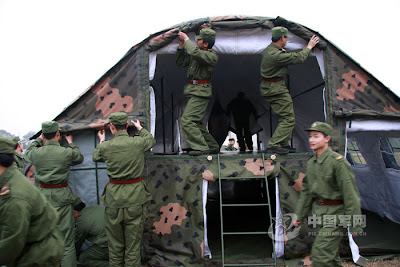
Camping make easy, PLA style
Small and inexpensive improvement really can make a different for those poor foot soldiers.




Friday, February 13, 2009
Wonder what type of bomb did they drop, daisy cutter?
Military exercise sparks earthquake panic in China
BEIJING (AP) — A military exercise in southern China set off mass panic among local residents who thought an earthquake had struck with about 100,000 people fleeing their homes, state media reported Saturday.
Frightened residents slept outdoors following the live-fire exercise Wednesday by an air force brigade near the city of Hengyang in Hunan province, the Xinhua News Agency said.
Pressure waves from exploding bombs shook homes and rattled windows, and rumors of an earthquake spread quickly by phone and over the Internet, the report said.
Earthquake fears spread throughout China after last May's massive temblor in Sichuan province that left about 90,000 people dead or missing. The 7.9 magnitude quake rocked buildings in Beijing and other cities thousands of miles (kilometers) from the epicenter.
"Apparently, the residents are more vigilant after the strong earthquake hitting Sichuan province last May," Xinhua quoted local official Liu Xinghua as saying.
Notices were issued by local governments on Thursday reassuring people that no earthquake had occurred, Xinhua said. Liu said he worked until 3 a.m. on Friday trying to persuade villagers to go back home, but "many of them still feel unsafe."
Wednesday, February 11, 2009
Latest issue of Joint Force Quarterly has two article related to China.
Enjoy.
Chinese Disaster Relief Operations
Chinese Disaster
Relief Operations
Identifying Critical Capability Gaps
By N i r a v P a t e l
http://www.ndu.edu/inss/Press/jfq_pages/editions/i52/22.pdf
China-Africa Relations
in the 21st Century
http://www.ndu.edu/inss/Press/jfq_pages/editions/i52/23.pdf
Chinese Disaster Relief Operations
Chinese Disaster
Relief Operations
Identifying Critical Capability Gaps
By N i r a v P a t e l
http://www.ndu.edu/inss/Press/jfq_pages/editions/i52/22.pdf
China-Africa Relations
in the 21st Century
http://www.ndu.edu/inss/Press/jfq_pages/editions/i52/23.pdf
Tuesday, February 10, 2009
What the hack is this "naval regiment"? Reading from the article, it does not seems to be a new unit of the PLA Marine and relatively new, do you think it is to be stationed on broad of the newly commissioned LHD?
Naval regiment carries out force-on-force exercise with Army unit
english.chinamil.com.cn 2009-02-10
A regiment of the South China Sea Fleet of the PLA Navy maneuvered to complicated hinterland areas to carry out force-on-force exercise with an Army unit as soon as the Spring Festival was over. The Army unit acts as the blue army and the naval regiment acts as the red army.
As the naval regiment was formed not long ago, it lacks experience of actual-troop confrontation in previous trainings, especially the experience of tactic confrontation exercise with simulated strong "enemy" in complicated electromagnetic environment. Since last year, to tackle such factors not good for actual-troop exercise including narrow area, familiar opponents and single-modal electromagnetic environment, the regiment has established collaborative mechanism for tactic training with brother troops of various arms and carried out tactical confrontation exercise frequently. It also organized exchanges on test and argumentation of new equipment and new fighting methods to realize resources sharing.
In the exercise, after receiving an order of cutting off all radio communication links with the outside of the blue army in 24 hours, the command station of the naval regiment immediately deployed 3 standby groups to rush to the position.
In less than 3 hours, all combat groups have come to the designated positions. The scout and searching result showed that the "enemy" was making contact with 10 external targets at the same time. The command station then issued an order of interference, several interference vehicles then launched strong "electro-magnetic wave" and the communication network of the "enemy" paralyzed in a sudden. Shortly, the "enemy" attempted to change frequency and communication mode, but the red army then made a decisive and orderly interference. After more than 10 hours' of fierce combat, the communication system of the "enemy" was destroyed compeletely.
By Zhang Shengzhong and Zhou Yawen
(Feb 9, PLA Daily) Editor: Fan Aifeng
http://english.chinamil.com.cn/site2/news-channels/2009-02/10/content_1646221.htm
Monday, February 09, 2009
Latest comments from Adm Keating, I am sure some of you will find it interesting.
No thaw yet in U.S.-China military ties - U.S. admiral
Fri Feb 6, 2009 2:16am IST
By Andrew Gray
WASHINGTON (Reuters) - The head of U.S. forces in the Pacific said on Thursday China had made no overtures to revive dialogue with the U.S. military since President Barack Obama took office but he was optimistic ties would improve.
China broke off high-level contacts with the U.S. military in October after the United States agreed a $6.5 billion arms sale to Taiwan, which Beijing considers a renegade province.
"I have seen no change since the new administration came in," Navy Admiral Timothy Keating, the head of U.S. Pacific Command, told Reuters in an interview at the Pentagon.
"We do have ongoing dialogue with ... certain folks in China," Keating said. "We would much prefer it to be a more formal, a more regular and a more frequent dialogue than it is right now and that's what we're working to achieve."
The United States has repeatedly called on China to explain the intentions behind the modernization of its armed forces and large increases in its military budget in recent years.
Beijing has stated it is committed to a "peaceful rise" alongside its rapid economic development and rejected U.S. accusations it has not been transparent.
Keating said the United States wanted to encourage "responsible behavior" by China.
He said he was heartened by Chinese participation in international anti-piracy efforts off the coast of Somalia. Chinese vessels were in contact with U.S. Navy ships there, he said. "There is ongoing dialogue at the tactical level so we are encouraged by that," Keating said.
"We think that there are ways for China to integrate into naval coalitions, to help with humanitarian disaster relief, so as to reflect a willingness to cooperate and collaborate," he said. "I'm optimistic about it."
U.S. and Chinese military officials exchanged visits throughout 2007 and 2008 until the Taiwan arms deal was announced, said Keating, who visited China twice as Pacific Command chief.
He said he hoped such contacts could resume as part of a return to more dialogue with the Chinese military.
http://in.reuters.com/article/worldNews/idINIndia-37866720090205?sp=true
Wednesday, February 04, 2009
Still no sign of the domestic engine WS-10A yet.
BBC Monitoring Former Soviet Union - Political
Supplied by BBC Worldwide Monitoring
February 4, 2009 Wednesday
Russia to supply over 100 fighter plane engines to China - Rosoboronexport
Text of report by Russian state news agency ITAR-TASS
Moscow , 4 February: Russia has signed its first contract in 2009 with China on the supply of over 100 aircraft engines for J-10 planes, Rosoboronexport Director-General Anatoliy Isaykin has said.
"The world's leading analysts think that the People's Republic of China will continue to buy military transport aircraft, including strategic refuelling tankers, long-range radar surveillance and carrier-borne aircraft, as well as aircraft engines. By the way, our first contract in 2009 was signed with China on the supply of over 100 aircraft engines for J-10 planes," Isaykin said in an interview with Nezavisimaya Gazeta published today.
"That country is also showing keen interest in air defence equipment. Our partners pay great attention to upgrading their navy through imports as well," he added.
At the same time, the Rosoboronexport head noted that the expanding geography and increasing volumes of Russian military exports "logically lead to the reduction of China 's share in our arms exports."
"It is quite likely that it may drop from 40 per cent to 10 per cent. We are not concerned about that because the volume of sales remains high," Isaykin predicted.
Source: ITAR-TASS news agency, Moscow , in Russian 0810 gmt 4 Feb 09
Monday, February 02, 2009
9th Artillery division, 1st Group Army, Nanjing MR, shows off its new toys.
走向数字化的中国炮兵——记率先列装陆军最先进300远火的南京军区某炮兵团
描述:图为某新型火箭炮在西部戈壁实弹射击。
http://www.chinamil.com.cn/site1/xwpdxw/2009-02/03/content_1638035.htm
新华网南京2月2日电(记者李大伟、梅世雄)人民解放军炮兵诞生于82年前的八一南昌起义。
1950年8月1日,炮兵司令部在北京正式成立。至此,被誉为“战争之神”的炮兵正式成为人民解放军的一个兵种。
1985年7月,为加强陆军部队的合成,除保留部分炮兵部队作为预备炮兵外,其余大部炮兵部队统一整编为集团军和步兵师的队属炮兵。
如今,炮兵正在成为集火力打击、战场侦察、电子对抗等于一身的多能数字化炮兵。
南京军区某炮兵团,就是炮兵阔步迈向数字化的一个典型缩影。
数字化
从步兵改建为炮兵,这个炮兵团经历了5次改制换装——
1951年2月,列装24门苏制M-13火箭炮,即著名的喀秋莎火箭炮。这是人民解放军第一支火箭炮部队;
1972年11月,列装63式19管130毫米火箭炮;
1985年10月,列装82式30管130毫米火箭炮;
1995年7月,列装81式122毫米火箭炮;
2003年和2005年,炮兵团先后列装某新型反坦克导弹和某新型火箭炮武器系统。
“第五次改制换装,具有革命性的意义。”炮兵团现任团长丁仕夫说,“这两种装备都是目前中国陆军最先进的主战装备,完全实现了数字化。”
25岁的炮兵团二营五连三班班长张坚对第五次改制换装有着刻骨的记忆。“之前,我们从计算诸元到操瞄调炮,再到构筑人员掩体,全部是纯手工作业。”他说,“现在,新型火箭炮全部是电脑控制。”
“0”和“1”,这两个普普通通的数字,使得现代战争发生了革命性的变化——“数字化生存”“数字化作战”“数字化战场”“数字化武器”“数字化部队”……
从“小米加步枪”的步兵到传统炮兵,再到数字化炮兵,伴随着人民军队波澜壮阔的伟大征程,组建于抗日战争烽火中的南京军区某炮兵团,正昂首挺立在新军事变革的潮头。
实弹射击
2008年深秋,茫茫西部大漠,狂沙飞舞。
阵地上,某新型火箭炮蓄势待发!它们刚刚从万里之遥的东南某地机动而来。
“10、9、8……3、2、1,发射!”团长丁仕夫沉着冷静地下达着口令。
瞬间,12发炮弹拖着长长的烈焰尾翼,以排山倒海之势集束射向目标,几十个钢铁目标灰飞烟灭!
具备如此强大的作战能力,炮兵团经历了一次又一次炼狱般考验。
5年前,38岁的丁仕夫走上南京军区某炮兵团团长岗位之时,这个团刚刚列装某新型反坦克导弹。全团官兵根据实际情况,自编训练教材,很快摸清搞透了新装备所有专业和战斗岗位。
2004年10月,皖东某山区,中国军队第一个合同战术训练基地。某新型反坦克导弹第一次实弹射击即将在这里打响。
当射击方案上报到指挥所时,现场的厂方专家大吃一惊:由他们拟制的射击方案被几个月之前还是某新型反坦克导弹“门外汉”的丁仕夫改了个面目全非。
原来,为确保首次实弹射击万无一失,厂方特意挑选了一台他们认为性能最好的战车担负射击任务,并选定了一名最优秀的炮手进行操作,连距离、角度等射击参数都提前固定好……
丁仕夫不能容忍任何有损新装备全方位形成作战能力的行为。他果断地修改了射击方案——新方案中,发射的战车由一辆变成了三辆,炮手由一名变成了三名,射击距离变成了三个不同值……
厂方专家反复劝说:“用同一台发射车、同一名炮手、打同一个目标,既安全,效果又好!”
“实弹射击的机会太难得了。”丁仕夫耐心解释,“我们就是要抓住点滴机会,让更多的装备接受检验,让更多的炮手得到锤炼。”
“轰……”“轰……”“轰……”随着3声撼天动地的巨响,3发导弹发发准确命中目标。
这次实弹射击的“满堂红”,为炮兵团争取到了更大的发展机遇。不久,某新型火箭炮武器系统又第一个交到了炮兵团。
驾驭新装备
一个团,在短短两年时间,就列装了两种中国陆军最先进的主战装备,这在全军部队极为罕见。
如同当年驾驭某新型反坦克导弹一样,操纵某新型火箭炮武器系统,又是一项没有任何经验可供借鉴的挑战。
全团官兵天天泡在训练场,仔细琢磨新装备系统定位、精确打击等18个专业、100多个战斗岗位,仅用3个月时间就绘制出新型火箭炮武器系统原理图,解决了新装备原理难掌握的问题。在此基础上,他们又编写出全军首套某新型火箭炮武器系统操作教材,为其他部队训练提供了范本。
某新型火箭炮武器系统列装炮兵团不到半年,便迎来了全军“第一炮”——2005年10月,火箭炮首次奔赴戈壁滩执行实弹射击任务。
那天9时,一连一炮炮长胡秋峰怀着激奋的心情,按下了某新型火箭炮武器系统“第一炮”的发射钮。
炮弹拖着长长的尾焰向着大漠纵深飞去。1分钟、2分钟、3分钟……原计划5分钟之后发射第2发,胡秋峰却迟迟没有收到发射指令。
此时,指挥所里,一场争论正在激烈进行——第一发炮弹是远弹,超越目标区,在场专家建议:“表尺减半修正”。
“不能修正!”丁仕夫高亢的声音让专家们一怔。
“已经仔细核对过,射击诸元没有问题。”丁仕夫胸有成竹,“从理论上讲,射击中可能出现5%的不规则弹,而参数是准确的。”
“我敢断定,这发弹就是5%范围内的不规则弹。”丁仕夫的据理力争,又一次说服了现场的专家。
“诸元不变,继续射击。”10时许,正在焦急等待的胡秋峰终于收到发射指令——数分钟后,炮弹准确命中目标。
“好装备,就是要交给你们这样的好部队。”军委领导高度称赞炮兵团官兵驾驭新装备的能力。
连建制齐射
丁仕夫和他的战友们没有沉醉于赞扬声中,他们向前来考察的军委领导建议:“以往,新装备都是实行单发射击……我们建议进行营连建制齐射,这样可以全面检验新装备效能,最大限度提升作战能力。”
此前,包括生产厂家在内,全军列装这种类型火箭炮的部队,都只进行过“单炮单发实弹射击”,“单炮满管齐射”“营连建制满管齐射”还只停留在理论上。
军委领导当即首肯:“这个效能检验射击任务就放在你们团!”
4个月之后,丁仕夫率领炮兵团官兵,又一次远赴大漠戈壁,进行某新型火箭炮首次连建制实弹效能检验射击。
这是一次具有开创性的实弹射击。
大漠的天,娃娃的脸。就在检验射击展开之时,日丽风和的天空突然狂风骤起,漫天的风沙吹打得炮身“沙……沙……”作响。
气象站通报,风速达17米/秒,远远超过火箭炮实弹射击的气象极限。
面对险恶的天候,阵地上却传出丁仕夫果断的口令:“修正诸元,射击!”
刹那间,整个阵地被掀起的狂沙淹没,数十发炮弹雷霆万钧般集束射向目标,发发炮弹均在目标区“开花”。
这次极限射击,使炮兵团收获了某新型火箭炮武器系统在最恶劣气象条件下的宝贵射击参数。
这次极限射击,实现了某新型火箭炮由打点到打面,由单发射击到营连建制齐射的战斗力飞跃。


Friday, January 30, 2009
Just finished Mulvenon's latest work
The conclusion is interesting as the article was published before PLAN goes to Africa.
Here it is, enjoy.
http://www.hoover.org/publications/clm/issues/37362544.html
Here it is, enjoy.
http://www.hoover.org/publications/clm/issues/37362544.html
Military Affairs — James Mulvenon
* Chairman Hu and the PLA’s "New Historic Missions"
Winter 2009:
Military Affairs
By James Mulvenon
"Chairman Hu and the PLA’s "New Historic Missions""
In a speech delivered on Christmas Eve 2004, Hu Jintao introduced a new set of "historic missions" for the Chinese armed forces. These missions constitute one part of a broader revision of the PLA’s "strategic guiding theory," derived in large measure from Hu Jintao’s overall ideological guidance on "scientific development." This article examines the timing, content, dissemination, and implementation of the "historic missions," which is a useful test case of Hu’s relationship with the PLA as reflected in military political work
Tuesday, January 20, 2009
The biggest news of today....
The 2008 national defense whitepaper is out!
Here is the link to the English version
http://english.gov.cn/official/2009-01/20/content_1210227.htm
Here is the link to the English version
http://english.gov.cn/official/2009-01/20/content_1210227.htm
Monday, January 19, 2009
Ukraine studies joint aircraft production options with China
19.01.09 16:53
Ukraine, Kiev, Jan. 19/ Trend News, Z. Novsvitski/
The Ukrainian Defense Ministry is considering the joint production of new L-15 military trainer aircraft with China, Minister Yuri Yekhanurov said after his 5-day visit to China.
L-15 is a new aircraft displayed at the Airshow China-2008. It is equipped with an engine made by the Ukrainian companies Progress and Motor Sich.
“The Defense Ministry has the capacity to implement these projects,” he said. “We are currently studying technical possibilities for repairing and overhauling our aircraft.”
He said cooperation between Ukraine and China would also be interesting by involving Russian companies.
“I think it is high time we hold trilateral talks and agree on joint projects to produce military and transport aircraft, as well as training officers for sea aviation and vessel production,” he said. “The cooperation seems promising. But I would like our Russian counterparts to also find common ground with us.”
Yekhanurov led a defense delegation to China from Jan. 13 to 18.
Have any feedback? Contact our journalist at: trend@trend.az
China planning its own full Earth GPS system by 2015
By Rick C. Hodgin
Monday, January 19, 2009 11:45
http://www.tgdaily.com/content/view/41086/113/
Beijing (China) - China's state media announced today that it plans to introduce its own set of geostationary orbiting satellites for a Chinese GPS system by the year 2015. The Beidou Navigation System (BNS) will enable its military and civilian users to find their way anywhere in the world without relying on the U.S. Global Positioning System (GPS).
According to Zhang Xiaojin, director of astronautics at China's Aerospace Science and Technology Corp, "The system will shake off the dependence on foreign systems." China plans to launch more than 30 satellites by 2015. Ten will be launched in 2009 and 2010. These will be added to the five it already has in orbit, according to the report.
The five-satellite system allows regional navigation throughout mainland China. As the new system expands it will eventually encircle the globe creating an alternative to the U.S. dominated GPS system in use today. China also views BNS as a rival to the EU's Galileo Position System and Russia's Global Navigation Satellite System (GLONASS).
GPS systems operate by receiving signals on the Earth from geostationary satellites which broadcast their location information constantly. While it only requires three sources to be able to triangulate a position, there are distortions in space-time around the Earth's gravitational field (as well as small ones introduced by the sun, moon and other planets). As a result, more than three satellites are used to correct for this error.
Some of the highest-end, several thousand dollar professional GPS systems with land-based augmentation are accurate to within one or two millimeters. The typical GPS found in most portable devices, including Garmins and TomToms, are accurate to within about 18 feet.
Friday, January 16, 2009
Told you, it is a dog-and-pony show
Zhang Yimou to direct Chinese anniversary parade
http://www.iht.com/bin/printfriendly.php?id=19420974
The Associated Press
Friday, January 16, 2009
BEIJING: Movie director Zhang Yimou will follow up his successful opening ceremony for the Beijing Olympics by orchestrating a celebration to mark the 60th anniversary of communist China, his assistant said Friday.
Directing the Oct. 1 celebration indicates how firmly Zhang, 57, is embraced by the ruling Communist Party after last year's Olympic opening ceremony that stunned television audiences around the world.
For a time, Zhang was considered a troublemaker and had several of his films banned.
Zhang made his career directing films such as "Raise the Red Lantern" and "To Live," unflinching stories about the hardships during China's turbulent 20th century that were not well received by Chinese authorities.
He later directed less gritty works such as "Hero" and "House of Flying Daggers," which made his work available to a wider audience in China and focused more on historical epic.
More than 40,000 people took part in the opening and closing ceremonies of the Olympics, using thousands of costumes and lavish stage sets. Zhang has said the task was much harder than making any film.
Now, Zhang has been given the task of organizing the celebrations marking the founding of the People's Republic of China, said the English-language China Daily newspaper, citing an unnamed senior Beijing municipal government official.
Zhang Jigang, a vice director of the Olympic ceremonies, will team up with the director to put on a "grand show," the report said. While the anniversary is celebrated every year, China normally puts on a bigger show every 10 years.
Zhang Yimou's assistant, Pang Liwei, confirmed that Zhang will be in charge of a gala on the evening of the anniversary but it was not clear what the event would involve.
The official Xinhua News Agency said the tone will be "solemn" rather than extravagant because of the financial crisis.
That means Zhang may have to rely on eye-catchers besides flying acrobats and an extravaganza of fireworks that marked the Olympic gala. The celebration will follow a parade of tanks and missile launchers that will show off the might of the People's Liberation Army.
The military parade will go down Beijing's main boulevard that crosses Tiananmen Square in the heart of the city, from where Mao Zedong proclaimed the establishment of the People's Republic of China on Oct. 1, 1949, after a civil war with the Nationalists, who fled to Taiwan.
Tuesday, January 13, 2009
So, the ROC ship allowed PLAN SpOp team to go aboard?
http://www.bloomberg.com/apps/news?pid=newsarchive&sid=alQMflQ8hgtE
http://www.bloomberg.com/apps/news?pid=newsarchive&sid=alQMflQ8hgtE
Chinese Naval Force Protects Taiwanese Ship From Somali Pirates
Email | Print | A A A
By James Peng
Jan. 13 (Bloomberg) -- A Chinese naval task force began escorting a Taiwanese merchant ship and three other vessels in the Gulf of Aden in a mission to protect them from Somali pirates.
Two Chinese special forces teams are aboard the merchant ships, which departed yesterday, the official Xinhua News Agency said. The Chinese destroyer Wuhan is accompanying the ships.
Ties between the governments in Taipei and Beijing have improved since Ma Ying-jeou became Taiwan’s president last May, ending the pro-independence stance of his predecessor.
China last month deployed vessels to escort merchant vessels along Somalia’s Indian Ocean coast and the Gulf of Aden after the United Nations Security Council authorized naval forces to fight pirates in the area. Buccaneers seized 40 ships last year.
A second destroyer, Haikou, will join the mission at a later stage, Xinhua reported. The vessels are among the most sophisticated in the Chinese navy, carrying anti-aircraft and anti-ship missiles, Xinhua said last month.
Between January and November last year, 1,265 Chinese commercial ships passed through Somalia’s waters, according to China’s Foreign Ministry. About one-fifth of those ships had confrontations with pirates, ministry spokesman Liu Jianchao said last month.
The Chinese force will escort the Taiwanese merchant ship as well as two vessels from Shanghai and one from the Philippines, according to Xinhua.
Taiwan and China, which regards the island as part of its territory, have been ruled by separate governments since the end of a civil war in 1949, when Mao Zedong’s victorious communist forces took control of China’s government and drove Chiang Kai- shek’s Nationalist army to Taiwan.
To contact the reporter on this story: James Peng in Hong Kong at jpeng7@bloomberg.net;
Last Updated: January 12, 2009 21:22 EST
US says reached dual-use trade deal with China
http://www.reuters.com/article/rbssTechMediaTelecomNews/idUSN1337694320090113
WASHINGTON, Jan 13 (Reuters) - The United States has reached a deal with China clearing the way for full implementation of a trade program for dual-use technology goods, the Commerce Department said on Tuesday.
"We are pleased to have reached this milestone agreement," Commerce Under Secretary Mario Mancuso said in a statement just one week before the Bush administration leaves office.
"U.S. exporters now have a more streamlined way to export to companies in China who have a record of using U.S. technology responsibly," Mancuso said.
The agreement is good news for U.S. aircraft manufacturer Boeing Co. (BA.N) and Applied Materials Inc. (AMAT.O), the world's biggest supplier of machines used to make semiconductors.
The two companies have partners in China cleared to import certain advanced technology goods that also have potential military uses.
The Commerce Department in 2007 imposed new export controls on a targeted list of high-tech goods sought by China's military, such as lasers, high-performance computers, extreme temperature telecommunications equipment and airborne communication and inertial navigation systems.
At the same time, it established a new "validated end user" program to allow pre-screened civilian companies in China to import certain controlled items without having to obtain an individual Commerce Department license.
Last month, Mancuso said the Commerce Department was considering suspending the program because it had not reached an agreement covering surprise inspection procedures for the five companies in China approved to participate.
The two countries have now reached a pact that "will maximize the security and trade-enhancing benefits of the VEU program and continue a promising chapter in civilian U.S.-China high technology trade," Mancuso said.
(Reporting by Doug Palmer)
China, U.S. Reach Accord on Advanced Technology Trade Program
Email | Print | A A A
By Mark Drajem
Jan. 13 (Bloomberg) -- The U.S. and China reached an agreement on a trade program for advanced technology that may aid companies such as Boeing Co. and Applied Materials Inc.
The agreement clears the way for American officials to conduct surprise inspections of the facilities of Chinese companies that want to be pre-screened for the program. If approved, the companies can receive advanced technology for civilian use, such as aircraft parts and computer hardware, which could be exploited for military purposes.
The Commerce Department had threatened to suspend the existing program without an agreement on surprise inspections.
“We are pleased to have reached this milestone agreement with China, one of our nation’s most important trading partners,” said Mario Mancuso, the top Commerce Department official for the export controls.
Saving the program would help Boeing, the world’s No. 2 commercial-plane maker, and Applied Materials, the largest maker of chip-production machinery, which had partners in China cleared to buy their equipment.
To contact the reporter on this story: Mark Drajem in Washington at mdrajem@bloomberg.net
Monday, January 05, 2009
I want to belive it, but I am going to take "wait-and-see" stand
TAIPEI (Reuters) - China may be planning to slowly reduce the number of missiles aimed at Taiwan in a significant show of goodwill towards the self-ruled island, a Taiwanese military official said on Sunday.
China has claimed sovereignty over Taiwan since 1949, when Mao Zedong's Communists won the Chinese civil war and Chiang Kai-shek's Nationalists (KMT) fled to the island. Beijing has vowed to bring Taiwan under its rule, by force if necessary.
But Beijing may be planning to remove some of its approximately 1,300 short-range and mid-range missiles aimed at Taiwan, which is about 160 km away, said island defence ministry spokeswoman Chih Yu-lan.
"We have some grasp of this situation," Chih said.
Relations between the two sides have already improved since China-friendly Taiwan President Ma Ying-jeou took office in May. His government has signed trade and transit deals with Beijing while avoiding displays of sovereignty for the island.
China's removal of missiles would be particularly popular with Taiwan's public compared with other recent goodwill measures, such as a gift of two giant pandas and financial incentives for Taiwan investors, political experts on the island say.
But Taiwan's military is not backing down, Chih said.
"We would look favourably at this development (in China), but we need to work on our own safety and not rely on someone else's goodwill," Chih said. "We won't relax our own preparations."
http://in.reuters.com/article/worldNews/idINIndia-37275920090104
Cool, another dog-and-pony show, you know how much I love'em
Military Parade on China's 60th Anniversary
Beijing, Jan 5 (Prensa Latina) The People's Republic of China will mark its 60th anniversary with a military parade showcasing the the People's Liberation Army´s latest weapons.
Despite the importance and solemnity of the national event, extravagance will give way to solemnity and the money so saved will be diverted to reconstruction projects in earthquake-hit areas.
The website of the People's Daily, the official publication of the Communist Party of China, recalled that those parades take place every ten years, when the People's Republic of China celebrates a round anniversary.
President Mao Zedong announced the foundation of the People's Republic of China on October 1, 1949, during a speech at Tiananmen Square, in downtown Beijing.
Tang Xingming, of the Armed Forces' Academy of Military Sciences, said the parade would showcae China's economic and military power.
China last held a massive military parade on Oct 1, 1999, when it celebrated the 50th anniversary of the founding of the People's Republic of China.
PLA's Chief of General Staff Chen Bingde will be in charge of the preparations for the grand military parade, the report said.
nm/jg/jhb
Subscribe to:
Posts (Atom)