This rare photo of one of China’s 24 imported Sikorsky Blackhawks: complete with four external auxiliary fuel tank pylons.
It is a perfectly illustrates why the PLA spent precious 1980s budget on a helicopter built for altitude, since the custom S‑70C‑2 variant came with more powerful 1690‑hp T700‑GE‑701A engines, a 3400‑hp Seahawk gearbox, high‑altitude weather radar, and long‑range VLF/Omega navigation, enabling it to perform 4500‑meter rescues, supply remote Tibetan border posts, and even reach 21,000 feet. A mission the Mi‑8, Mi‑17, and Z‑8 of the era simply couldn’t perform
Helicopters were indispensable during the May 12, 2008 Sichuan earthquake, providing the only way to reach isolated mountain towns, evacuate survivors, deliver medical teams, and move supplies when roads collapsed and landslides cut off every ground route. A lesson the Chinese learned with blood
Here is my assessment on the PLA's response to the May 12th 2008 earthquake
(Special thanks to Michael Little and William Murray)
A
major earthquake measuring 7.8 on the Richer Scale jolted southwest
China's Sichuan Province at 2:28 p.m. on Monday, May 12th, 2008. With
more than 70,000 deaths, this earthquake was one of the largest natural
disasters to hit China in recent memory. The Chinese government’s
reaction to this disaster was swift, with tens of thousands of troops
dispatched to the area within a short period of time with reactions from
the highest echo of the civilian leadership, most noticeably Prime
Minster Wen Jiabao[1]. This was coupled with aggressive media coverage,
making it a major departure from China's past tendency to control media
access during crises. Because of these two factors, this terrible
disaster gives analysts both inside and outside of China a real
opportunity to assess the PLA’s operational capabilities. While no one
questioned the PLA’s dedication and enthusiasm, some veteran PLA
watchers were “underwhelmed” [2] by what they saw. That sentiment is
shared by this author as well.
This paper is an attempt to assess
and summarize the PLA’s reaction and performance by using the PLA’s
own released news and reports to review what lessons can be drawn from
the official response to this natural disaster.
The Force Deployment Timeline:
The following timeline of the PLA’s deployments in response to the earthquake is compiled from official sources.
When
the earthquake occurred, local PLA units stationed at and near Sichuan
started to repair roads and carried out rescue and relief operations.
According to the
PLA Daily[3]
an armored regiment of the Chengdu Military Region (MR) raced to
Beichuan County, and an artillery regiment headed straight for Wenchuan
County immediately after the quake occurred. The official report
states that they were mobilized immediately on orders from General Li
Shiming, commander of Chengdu MR, as part of a pre-planned emergency
procedure activated after a direct communication from President Hu
Jintao. During the first hours after the quake more than 6100 troops
from the surrounding regions of Chengdu MR were also ordered to the
disaster area. Local commanders of the Lanzhou MR additionally
mobilized 5,000 offices and men into rescue relief operations in the
southern part of Gansu Province [4] where the earthquake had caused
significant damage.
[1] Andrew
Jacobs “In China quake, apotheosis of ‘Grandpa Wen’ International
Herald Tribune http://www.iht.com/articles/2008/05/21/asia/21wen.php
(last accessed 8/13/2007)
[2] Jake Hooker, “Unearthed in quake:
Flaws in Chinese military capability” International Herald Tribune
http://www.iht.com/articles/2008/07/01/asia/china.php (last accessed
June 30th 2008)
[3] Large numbers of troops arrive at quake-hit
areas PLA Daily Online Edition
http://english.pladaily.com.cn/site2/news-channels/2008-05/14/content_1246484.htm
(last access June 30th 2008)
[4] IbidNone of
the news reports released on the first day (May 12th) mentioned CMC,
and this is a good indication that the special law on emergency
management that passed last year, which allows regional network of
emergency management offices to report directly to the State Council, is
having an effect [5]. While CMC’s Leading Group Office (LGO) for
Earthquake Rescue and Relief Work was established on the morning of May
13th to coordinate the actions of troops in earthquake rescue and
relief operations under the command of Chen Bingdu, members of the CMC
and the chief of general staff of the PLA [6] , some high readiness
rate units from different regions had already arrived in Chengdu,
including 300 troops from the 127th Light Mechanized Infantry Division
of the Jinan MR and the first batch of airborne troops. This totaled
6500 troops by 16:00 on May 13th [7].
May13th saw the largest
airlift in a single day in PLA history with 11,420 troops flown in by
12 civilian passenger airliners and 22 military transports[8], thus
pushing the number of troops arriving in the quake area to almost
20,000. This was in addition to 15,600 of the military reserves and
militia, and 5000 People’s Armed Police (PAP), with 30,000 more en
route [9] .
By 22:00 May 14th, 81,000 PLA and 14,000 PAP
personnel were engaged in the rescue and relief operations [10] . Of
those 81,000 PLA troops, there were 4,000 airborne, 2,600 Marine,
Naval, and Air Force personnel, and troop units directly affiliated
with the CMC’s four general headquarters/departments. The PAP troops
were mostly from Sichuan and Chongqing contingents.[11] Some GongAn
(Unarmed Police) from outside of Sichuan provided an additional 1,000
personnel, charged with the job of enforcing public security. [12]
[5]
Peter Ford “China moves quickly in quake zone’ The Christian Science
Monitor http://www.csmonitor.com/2008/0513/p01s04-woap.html (last
accessed June 20, 2008)
[6] Dong Qiang “PLA leading group for
earthquake rescue and relief work set up” PLA Daily Online Edition
http://english.pladaily.com.cn/site2/news-channels/2008-05/14/content_1246485.htm
(last accessed July 14th 2008)
[7] Large numbers of troops arrive at quake-hit areas.
[8]
“Chinese Army's largest airlift to take 11,420 troops to quake-hit
province” PLA Daily Online Edition
http://english.pladaily.com.cn/site2/news-channels/2008-05/15/content_1248358.htm
(last accessed July 14th 2008)
[9] Almost 20,000 soldiers
arrive in quake-hit SW China, 30,000 more coming PLA Daily Online
Edition
http://english.pladaily.com.cn/site2/news-channels/2008-05/14/content_1245479.htm
(last accessed July 14th 2008)
[10] “Facts and figures about
disaster relief work by PLA and APF on May 14” PLA Daily Online Edition
http://english.chinamil.com.cn/site2/special-reports/2008-05/15/content_1258875.htm
(last accessed July 14th 2008)
[11] Fei Boyu “Chinese PLA and APF
sends 95,000 troops to quake-hit areas” PLA Daily Online Edition
http://english.chinamil.com.cn/site2/special-reports/2008-05/14/content_1258870.htm
(last accessed July 14th 2008)
[12] “6 public security special
police officers arrived to carry out duties” The Ministry of Public
Security of PRC
http://www.mps.gov.cn/n16/n8357/n1176644/n1176685/n1176747/1180539.html
(last accessed 7/1/2008)
On 08:00 May 15th,
the number of troops engaged in rescue and relief operates reached
130,000. 28,000 troops arrived in 21 trains, along with 157 railcars of
rescue machinery and ambulances, seven railcars of oil and 69 railcars
of steel and other materials. The number of medical teams reached 72,
composed of some 2,160 military doctors and assistants [13]. 6,800
PLA parachutists were in Deyang and Mianzhu cities and Wenchuan County,
to help relief work.
By 22:01 May 16th, 61 PLA helicopters had
arrived at the quake-hit Sichuan Province with fifteen additional
helicopters from civilian agencies. On May 15, Premier Wen Jiabao
ordered 90 more helicopters (60 military and 30 civilian) for rescue
missions. [14]
As of 17:00 May 17th, more than 148,000 military
troops, armed police, militia and reservists were engaged in rescue
operations. 10,000 unarmed police from 28 Chinese cities also
contributed to the rescue operation [15]
Rapid Reaction:
Judging
from official media reports, there are aspects of the PLA’s reaction
that seem to confirm a number of theories brought forward by PLA
watchers over the years regarding the PLA’s chain-of-command during an
emergency. These held that the PLA has a number of Rapid Reaction Units
(RRU) stationed throughout China that will be activated and placed
directly under a single centralized command created from CMC’s General
Staff Department (GSD) in response to an emergency.
The PLA’s
initial response seems to confirm those theories in which designated
RRUs such as the 15th Airborne Corps, PLA Marines, 149th Mechanized
Infantry Division, elements of the 38th and 39th Group Armies (GA),
strategic units from Jinan MR such as the 127th Light Mechanized
Infantry Division (LMID), and 58th Mechanized Infantry Brigade and 60th
Motorized Infantry Brigade of 20th GA, were activated within the first
12 hours. The above list of RRU should come as no surprise to anyone
who watches the PLA as many previous reports portray their RRU
roles[16] .
[13]
“130,000 troops in rescue operations throughout quake area” Daily
Online Edition
http://english.pladaily.com.cn/site2/news-channels/2008-05/16/content_1251758.htm
(last accessed July 14th 2008)
[14] “Chinese premier orders
deployment of 90 more helicopters for quake relief”
http://english.peopledaily.com.cn/90001/90776/90785/6410903.html
People’s Daily Online Edition (last accessed June 12, 2008)
[15]
“GongAn dispatch an additional 5000 more police to the Sichuan
disaster zone ” The Ministry of Public Security of PRC
http://www.mps.gov.cn/n16/n8357/n1176644/n1176685/n1176710/1244164.html
(last accessed 7/1/2008)
[16] Dennis Blasko wrote number of good articles related to PLA’s RRUs including:
"PLA
Force Structure: A 20-Year Retrospective," in Seeking Truth from
Facts, ed. James C. Mulvenon and Andrew N.D. Yang (Santa Monica, CA:
RAND, 2001) and “The Chinese Army Today: Tradition and Transformation
for the 21st Century” Routledge, 2005.
Initially,
RRUs were operating from their contingency plans instead of a
centralized command and confusion did occur; for example, the 127th
LMID were to be transported to Sichuan by rail, but the action plan was
changed to airlift from Luoyang Airport after it was realized that
railroad lines were out of commission because of the large number of
tunnels collapsed from the quake . [17] It took Premier Jiabao less
than two hours to board an airplane and head to the quake zone, but the
CMC’s LGO, it was not operational until the morning of May 13th to
serve as the centralized command for PLA.
But what we really saw:
The
lack of heavy airlift transports was a much discussed topic within
China and on the PLA Daily’s own online discussion forums, as the PLA
relied heavily on civilian airlines for personnel transportation [18]
and reserved its 14 Il-76 heavy transports for specialized purposes
such as telecommunication devices, ambulances, tents, medical supplies,
etc.[19] Two of the Il-76s were dispatched to Beijing to pick up an
emergency rescue team with 150 members and 12 search and rescue dogs
from an engineering regiment of the 38th Group Army[20] at 22:30 on May
12th. That rescue team is considered China’s best and has taken part
in nine earthquake rescue operations including four outside of China
(Algeria, Iran, Indonesia and Pakistan). Sadly, it is the only one in
China[21] .
[17] Civilian
airlines assemble for the arrival of a Mechanized Infantry Division in
Luoyang Airport Xinhua News
http://big5.xinhuanet.com/gate/big5/news.xinhuanet.com/newscenter/2008-05/13/content_8158637.htm
(last accessed July 14th 2008)
[18] Xu Sihai “PLA makes
large-scale requisition of civil aircraft for the first time” PLA Daily
Online Edition
http://english.pladaily.com.cn/site2/news-channels/2008-05/19/content_1259063.htm
(last accessed June 12, 2008)
[19] Fei Boyu “Three
characteristics in disaster relief” PLA Daily Online Edition
http://english.chinamil.com.cn/site2/special-reports/2008-05/18/content_1262643.htm
(last accessed June 12, 2008)
[20] “Beijing MR Engineering
Regiment: 150 personal and 12 search dogs send to quake zone” PLA
Daily Online Edition
http://www.chinamil.com.cn/site1/2008a/2008-05/27/content_1282152.htm
(last accessed June 12, 2008)
[21] Ibid

The
fourteen Russian-built IL-76 heavy transports were far from sufficient
in addressing PLA’s airlift needs, and the PLA Daily’s own discussion
forum, surprisingly, became the home of the loudest critics. It will
impossible to argue that CMC does not realize this shortage exists, as
General Cao Guangchuan personally ordered an additional 38 cargo
versions of the IL-76 transport back in 2005, however the deal fell
though due to delivery delays and pricing issues[22]. During the three
years before the quake, there was no major attempt to beef up the
fleet with the cheaper, although somewhat less capable, locally-made
Y-8 military cargo plane.
While large numbers of troops arrived
to the quake zone very quickly they were not properly equipped, some
armed only with spades, and newspaper articles are filled with stories
about how troops picked at debris with their hands.
[22]
“Russia Scrambles to Save China Plane Contract” Defense News
http://www.defensenews.com/story.php?F=2107706 (last accessed September
16th 2006)
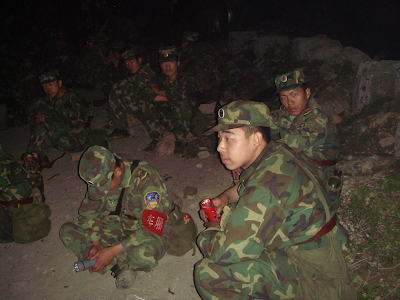
Search Party of 127th LMID…………armed only with flashlights.
Not
until day three, when heavier equipment finally arrived to the quake
zone, did the situation began to change. But, by then, the first 36
so-called golden hours had passed and chances of finding survivors
quickly faded. This lack of heavy equipment really handicapped the
rescue effort during the first hours of the earthquake. As noted before,
an armored regiment of the Chengdu Military Region (MR) was sent to
Beichuan. However, they were not able to reach the razed town with their
vehicles as all the roads were heavy damaged, hence and had to walk
there on foot. The road was not reopened until 18:00 on May 15th when an
emergency engineering unit of the Second Artillery arrived, with heavy
construction equipment such as large excavators, loaders, mobile
power-supply vehicles and portable power-supply stations.[23]
The
lack of real-time intelligence gathering capabilities also handicapped
the PLA’s search for survivors. Looking at photos released by the both
foreign and Chinese media, there was no attempt to take advantage of
UAVs currently in service with the PLA to track down survivors trapped
in remote mountainous regions. While PLA airborne forces conducted some
dangerous airdrops and reconnaissance in very poor weather in their
attempt to search remote survivors, without good intelligence their
efforts were not as successful as they should have been.
[23]
Wang Yongxiao and Xia Hongqing “Quake-damaged road from Mianzhu to
Beichuan opens to traffic” PLA Daily Online Edition
http://english.pladaily.com.cn/site2/news-channels/2008-05/16/content_1252466.htm
(last accessed June 12, 2008)
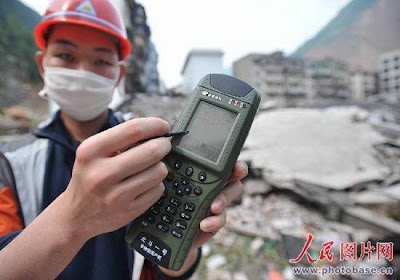
Rescuer calling for more Beidou GPS [24]
There
are only two aerial photographic airplanes in service with the
Surveying and Mapping Bureau of the PLA General Staff Headquarters [25],
which hardly seems enough. China also utilized 15 indigenous
satellites to help with the quake relief effort[26] but that a request
was made to the US for additional satellite images clearly showed the
shortcomings of the Chinese systems. The PLA also faced difficulties
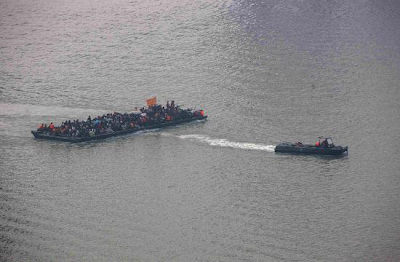
in evacuating survivors once they were located, as all the roads were
damaged and only the PLA Marines were equipped with speedboats and
pontoons that were capable of moving them out along the waterways.
[24]
Sichuan Mianzhou: Beidou call “Come to me, it is critical here”
People’s Daily Online
http://pic.people.com.cn/GB/8229/123030/7253862.html (last accessed
July 23, 2008)
[25] Liu Jihong and Ma Dong “Aerial surveying and
mapping offers precise geographical information” PLA Daily Online
Edition
http://english.pladaily.com.cn/site2/news-channels/2008-05/22/content_1268928.htm
(last accessed June 12, 2008)
[26] “15 Chinese satellites in
space help with quake relief efforts” PLA Daily Online Edition
http://english.chinamil.com.cn/site2/news-channels/2008-05/22/content_1268942.htm
(last accessed June 12, 2008)
[27] David Morgan “China seeks US
satellite data on quake” Reuters
http://www.alertnet.org/thenews/newsdesk/N15341365.htm (last accessed
June 18, 2008)
The
coordination between search parties of the 15th Airborne Corps and the
transportable troops of the PLA Marines was not smooth during the
first few days, so by May 19th the CMC had sent an additional 170,000
sets of radios to the troops with 62,000 sets arriving on that day[28] .
While the coordination between different PLA units experienced
difficulty, communications and support between PLA and PAP seemed
almost nonexistent in the early stage of the rescue work and the PLA
did not seem too interested in sharing some of the supplies. For
example, while the PLA’s General Logistic Department dismissed fears of
a food supply shortage, boasting that 300,000 daily field rations were
airdropped and hot food were available,[29] there were a number of
reports that PAP personnel had only cold steamed buns, yams and dry
noodles to eat.
[28] Dong
Zhaohui “PLA general headquarters/departments send radio sets to relief
troops” PLA Daily Online Edition
http://english.pladaily.com.cn/site2/news-channels/2008-05/21/content_1264932.htm
(last accessed June 12, 2008)
[29] “China dismisses worries
of food supplies for armed forces in rescue operations” PLA Daily
Online Edition
http://english.pladaily.com.cn/site2/news-channels/2008-05/19/content_1257444.htm
(last accessed July 12, 2008)
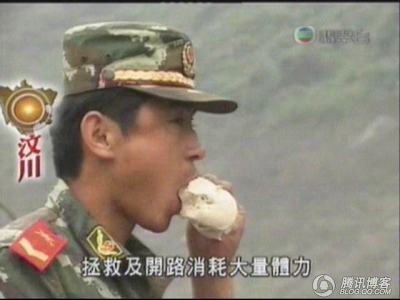
HongKong’s TVB reported PAP had only steamed buns and yams to eat
Another
item relating to shortfalls that drew much criticism within the PLA
and the Chinese press during this earthquake was the lack of transport
helicopters. At its peak, the PLA mobilized close to 150 helicopters
out of a total of 500 available.[30] Even at that, 150 helicopters
were not sufficient to handle all the critical work. To most
economically employ this small fleet of important assets, the LGO
ordered helicopters to be concentrated in the airdrop of drugs, food,
drinking water, garments and quilts, and tents to meet the survivors'
needs; and in the evacuation of wounded persons.[31] However, they
were thus not available for troops transport, communication and other
logistic needs.
[30]
“Chinese generals discloses the Army Aviation Force to the Foreign
Military Officers” Xinhui News
http://www.chinanews.com.cn/gn/news/2008/07-04/1302838.shtml (last
accessed July 23, 2008)
[31] Fei Boyu “Three characteristics in
disaster relief” PLA Daily Online Edition
http://english.chinamil.com.cn/site2/special-reports/2008-05/18/content_1262643.htm
(last accessed June 12, 2008)
Lessons learned:
The
PLA did the best they could with the limited assets they had, and no
one with their right mind would question their dedication and
enthusiasm. To continue the tradition of
“seek truth from facts,”
this horrible natural disaster provides a long list of items the CMC
must improve on. On June 19, in the aftermath of the earthquake, the
PLA launched its first drill for long-range air drops in emergency
situations with the following stated goal:
“The drill was
designed to train and test the ability of the PLA to mobilize military
and civilian aircraft to transport and air drop materials and rescue
forces in emergency situations……… The Chinese military has upgraded the
importance of the PLA's long-range airborne ability after the Sichuan
quake when most of the overland rescue forces were stranded by rock and
mud slides on the way to epicenter.” [32]
It also hosted a
critical care medicine conference to “sum up preliminary experience of
medical assistance of the PLA in quake recues and relief operation” [33]
Other studies are also being carried out. [34] In late July, the
CMC also added training on Military Operations Other Than War (MOOTW)
into their new doctrine, the Outline of Military Training and
Evaluation (OMTE)[35].
China also realized that natural
disasters might be too large for a single government to handle and on
June 13th, China called for an “ASEAN+3 (China, Japan, the Republic of
Korea) workshop on disaster relief by armed forces” to help in reaching
a basic consensus on disaster relief, to step up cooperation, [36]
and develop a plan of Standard Operating Procedures for armed forces in
humanitarian operations in coordination with UN humanitarian
organizations and other international assistance organizations [37].
If
there one thing PLA learned, it is that they no longer have do
everything alone and accepting foreign help might not be a sign of
weakness, but rather a proof of strength.
[32]
“PLA launches first drill for long-range air drops in emergency
situations” PLA Daily Online Edition
http://english.pladaily.com.cn/site2/news-channels/2008-06/19/content_1322937.htm
(last accessed July 20, 2008)
[33] Sun Lihua “PLA second critical
care medicine conference held in Changchun” PLA Daily Online Edition
http://english.chinamil.com.cn/site2/news-channels/2008-07/14/content_1361934.htm
(last accessed July 20, 2008)
[34] Guo Jiangshan
“Quake-rescue-and-relief subjects study carried out” PLA Daily Online
Edition
http://english.chinamil.com.cn/site2/news-channels/2008-07/23/content_1375957.htm
(last accessed July 20, 2008)
[35] Liu Feng'an “New Outline
of Military Training and Evaluation promulgated” PLA Daily Online
Edition
http://english.chinamil.com.cn/site2/news-channels/2008-07/25/content_1379311.htm
(last accessed July 25, 2008)
[36] “ASEAN+3 workshop on disaster relief urges more co-op” PLA Daily Online Edition
http://english.chinamil.com.cn/site2/news-channels/2008-06/13/content_1313890.htm (last accessed July 20, 2008)
[37]
“China proposes disaster relief cooperation plan at 10+3 workshop”
PLA Daily Online Edition
http://english.chinamil.com.cn/site2/news-channels/2008-06/12/content_1313275.htm
(last accessed July 20, 2008)


