Pakistan to get Chinese AEW&C aircraft this year
By Leithen FrancisDATE:07/05/10SOURCE:Flight International
http://www.flightglobal.com/articles/2010/05/07/341584/pakistan-to-get-chinese-aewc-aircraft-this-year.html
Pakistan has received its second Erieye radar-equipped Saab 2000, and will also accept its first Shaanxi ZDK-03 airborne early warning and control system aircraft before year-end.
Islamabad has four ZDK-03s on order, with deliveries due to start later this year, say air force sources. The type is a new variant of the Shaanxi Y8 AEW&C aircraft designed specifically for Pakistan.
The Chinese aircraft is powered by four turboprop engines and has a greater range than offered by the Saab Microwave Systems Erieye, the sources say.
The air force recently received its second Saab 2000 surveillance aircraft, and anticipates that it will receive its remaining two in the second and third quarters of this year.
Pakistan's move to source AEW&C aircraft from both China and the West is indicative of its strategy to refrain from being overly reliant on any one ally. The USA imposed military sanctions against Pakistan from 1990 to 2005 in response to its testing nuclear weapons.
The air force's current fleet includes Lockheed Martin F-16s, Dassault Mirage III and 5 fighters, Chengdu F-7s and JF-17s; a new type developed jointly by China and Pakistan.
In terms of military transports, Pakistan flies Lockheed C-130s, but also operates Ilyushin Il-78 tankers.
Thursday, May 13, 2010
Pakistan to get Chinese AEW&C aircraft this year


Tuesday, May 11, 2010
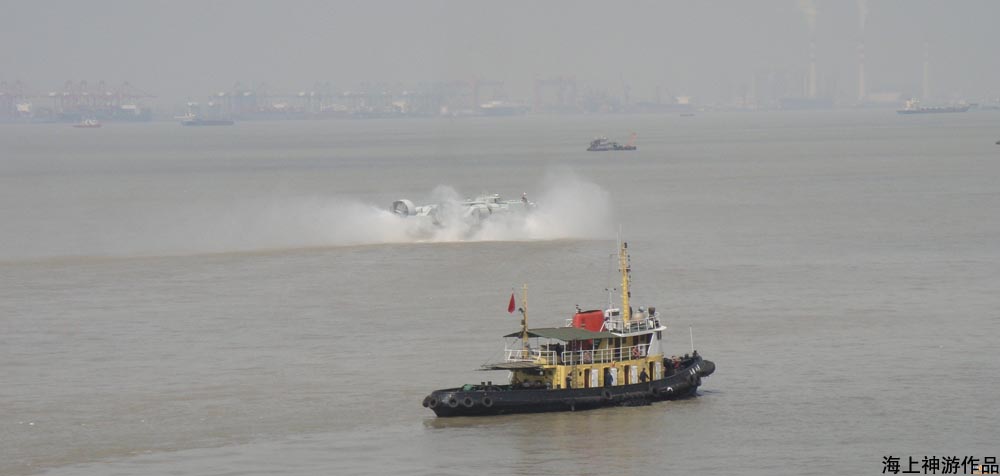
Shanghai, LCAC, and a new LPD under construction??
Photo of PLAN's Type 071 Yuzhou class LPD under construction four years ago.
 Photo taken May 10th 2010.


 Photo taken May 10th 2010.




US-China Cooperation on North Korea and Iran
Why waste two hours of your time on a mindless summer action flick when you can watch the latest C-SPAN video on “US-China Cooperation on North Korea and Iran” for free? For those of you who are interested in international relations, the program is a good watch.

Scholars talked about cooperation between the U.S. and China in addressing the nuclear programs of Iran and North Korea. Following their remarks they answered questions fro the audience. This program was part of a day-long Brookings Institution forum on U.S.-China cooperation on global issues.
* Fro?? yes, even C-SPAN is allowed to have a typo.....
Monday, May 10, 2010
2nd PLAN Marine Brigade.
The PLA Marine celebrates its 30th anniversary with its very own "PLA Style" parade this week – lockstep marching phalanxes, well rehearsed fire demo, and of course, go-go boot girls (here). Perhaps it is time to review the PLAN Marine’s “step child:” the 2nd brigade.
The 1st PLA Marine Brigade has been playing the role of a show-case unit for the PLA. As such, it has received a great deal of media coverage and played host to many foreign port calls. Some of its drills were open to foreign observers, including a joint training exercise with the USMC's 31st Marine Expeditionary Unit in Dec 2006. During the aftermath of the 2008 Sichuan earthquake, 2000 members of the 1st Marine were dispatched to the quake zone and subsequently won praise for its professionalism. In contrast, the 2nd Marine brigade has been out of the spot light since it was transferred from the ground force to the navy in 1998. After 10 years of prolonged reorganization, only recently has the Chinese media covered the 2nd's drills and activities. Judging from the media report, most of the 2nd Marine’s equipment are “hand-me-downs” from the 1st.
Before the transfer, the 2nd marine brigade was under the command of the 41st Group Army, Guangzhou MR as the 164th "training" Division. The 164th was commissioned in April 1952 by combining the 655th regiment from the decommissioned 219th division and the 434th regiment from the 145th division. The 434th regiment was renamed the 657th regiment in due course.
In March 1957 the 164th was deployed to Zhanjiang to guard the newly created South Sea Fleet HQ while the 655th regiment was in Zhiman, the 656th regiment in Suixi and the artillery regiment at Su Ling. The 657th regiment rejoined the 164th in November 1960.
In September 1964, the 164th was promoted to “Southern China Category A Unit” with improved combat readiness in response to the Indochina Crisis heating up. As part of China’s possible intervention force into Indochina, the 164th was reformed to take on additional artillery and engineering assets and its three regiments were renamed to the 490th, 491st, and 492nd regiments in 1970. It remained a Category A unit until January 1976 after the “Vietnamese civil war” ended.
During the Sino-Vietnam war of 1979, the 164th was augmented with the 2nd Engineering regiment, Nanjing MR, and took place in some of the heaviest fights. After 24 days, including the final battle of Lang Shan, the 164th suffered 229 KIAs (12 officers and 217 enlisted) and 663 WIA's, while claiming 2195 enemy causalities.
During the PLA’s one million troop cut in 1984, the 164th was ordered to transfer its 490th into a police unit thus leaving it with only two line infantry regiments. The 490th would later become the 8th People’s Armed Police Zhi-du, Guangdong Province.
The 164th’s military role continued to diminish. In 1986 it was converted into a training unit and disbanded one of its hollowed–out regiments in 1989. After injecting cadets from the 1st marine brigade, the 164th was transferred to the command of the PLAN in 1998. If the 164th had not transferred it would have become an historical footnote.
First Marine Showing off.


1st Marine is now equipped with the ZTS04 Amphibious family AFV .

1st Marine's H816 Vs 2nd Marine's


2nd's Marine's "hand-me-downs" -- Type 86B IFV, Type63A AALT, and Type63C AAPC.


Sunday, May 09, 2010
PLAN Magazine Photos.
Photos from June issue of " Naval and Merchant Ships", "Shipborne Weapon" and "Modern Ships"


9th round of the Joint Sino-Vietnam patrol kicks off.
Both sides will jointly patrol the CFZ (Common Fishery Zone) which includes parts of China and Vietnam's exclusive economic zones in the Beibu gulf. The CFZ was defined by two pacts signed in 2000 that took effect in 2004. Only licensed fishing boats are allowed to fish in the zone.


Subscribe to:
Posts (Atom)