China’s AWAC fleet has been expanding fast enough that even the public domain can barely keep up, and now we’ve got another one to add to the collection. The KJ‑700 program first surfaced last year with a pair of SLARs — AESA panels mounted behind each wing. The latest variant spotted online now carries four SLAR arrays, with two additional panels mounted ahead of the wings.
In other words: the KJ‑700 just went from “interesting” to “okay, now they’re getting serious.”
Given all the recent speculation about the PLA using AWACS to cue extra‑long‑range AAMs (PL-15. PL-17) deep into the battlespace, adding more airborne early‑warning platforms makes sense. The technology is clearly mature, the Y‑9 airframe is rolling off the line in healthy numbers, and China has shown it can scale these systems the way the BYD scaled EVs; quietly, steadily, and relentlessly.
Meanwhile, some critics still insist on evaluating air combat through fighter spec sheets, arguing about “4.5‑gen plus‑plus‑plus” like it’s 2007. But numbers matter, and recent conflicts have made that painfully obvious. A fighter is only as good as the sensor network feeding it, and China is building that network one turboprop at a time.
Napoleon said the troops you have, ready and present, matter more than the larger force that isn’t there. The same applies to AWACS: the platform you can actually put in the sky today beats the hypothetical stealth super‑AWAC someone might import tomorrow. And China, for better or worse, is putting them in the sky.


Monday, September 15, 2025
What Was Left Out of China's September 3rd Military Parade: KJ-3000 AEW&C
A newly surfaced photo on the Chinese internet, dated yesterday (September 14), shows the continued flight testing of the "7821" airborne early warning and control (AEW&C) aircraft.
The KJ-3000 remains in its prototype phase and has not yet entered active service. As with the official policy, only operational platforms are eligible to participate in military parades, excluding experimental or pre-production models such as the KJ-3000.

Thursday, May 29, 2025
Y-20 AEW&C Aircraft (w/KJ-3000 Airborne Radar)
Back in Dec 2023, Chinese military circles started to discuss a new AEW&C Aircraft based on the Y-20 transport platform (link) and (link). Considering that China is experienced in integrating Russian IL-76 with its own phased array radar (PAR) by Shaanxi Aircraft Corporation since early 2000, upgrading both radar and the aircraft with Y-20 seems to be a straightforward next step.
Of course, a photo released in January 9, 2024 (see below) by AVIC, featuring youthful designers and a fairly large model of the new AEW&C, adding credibility to the ongoing discussion.

Photos fro Dec 27th 2024


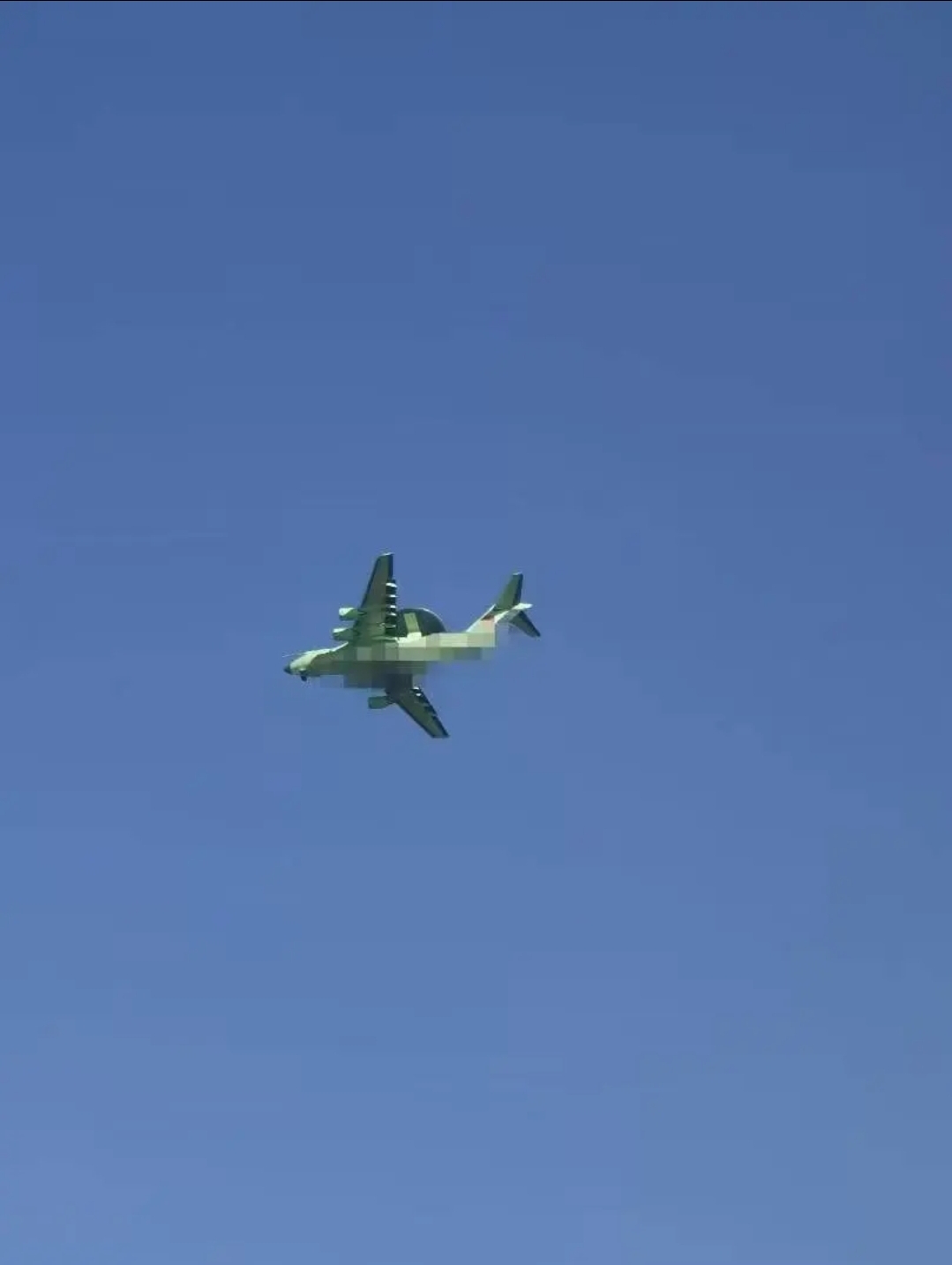
and now this, May 28, 2025

Saturday, October 03, 2009
KJ-2000 AWAC's Radar, An Inside Look.


Saturday, September 20, 2025
KJ500A AWAC on display
At the current Changchun Airshow


Wednesday, May 20, 2026
Photo of the day: PL-17 Beyond-visual-range missile mounted on J-11BG
Ha — PL‑15 is practically vintage at this point, so 2025. The new PL‑17 BVRAAM, the follow‑on to the PL‑15 that grabbed international headlines on May 7th, 2025, is now moving into the integration phase. And it’s not just for the shiny new J‑16s and J‑20s, the PLA is already retrofitting it onto older airframes like the J‑11, which says a lot about how central this missile is becoming to their long‑range air‑combat doctrine.


Sunday, February 22, 2026
PLAAF J-11B to J-11BG
A J‑11B equipped with an AESA radar and capable of carrying the advanced PL‑10 and PL‑15 air‑to‑air missiles. See Central China TV capture below
The J‑11B was the first PLAAF Flanker variant to feature fully Chinese‑developed avionics, weapon systems, and engines. Throughout the 2000s and 2010s, it formed the backbone of China’s air combat fleet, long before the J‑10, J‑16, and J‑20 entered service in significant numbers.
Even today, although the J‑11B is no longer the headline platform of the PLAAF, nearly 300 aircraft (including both J‑11A and J‑11B variants) remain in service. Upgrading these airframes to the J‑11BG standard central on AEDA radar appears to be a straightforward and logical decision for PLAAF leadership.
The PLA’s long‑standing approach to foreign military procurement is consistent: acquire systems from abroad, absorb the technology, and ultimately transition to fully indigenous solutions, one way or another.

J-11B front, J-11BG back

Bonus photos of J-11GBH of the PLA Naval Aviation (H=Hai or Ocean)


No comments:
Post a Comment