The PF-98 "Queen Bee" 120mm is, for me, the purest expression of PLA infantry weapons design. It's not particularly high-tech. It's not state of the art. It is simply a weapon built to do a job, do it reliably, and be produced in large numbers without breaking the bank. And yes, the "be produced in large numbers" part is probably the most important feature of all.
Nothing flashy here. Sure, it's about 3 kg heavier than the old RPG-7/Type 69 RPG family (11 kg versus 7 kg), but it's still portable enough for a single soldier to haul around. The PLA has increasingly pushed the PF-98 down to the squad level, where it fills just about every fire-support role imaginable: anti-tank, anti-bunker, anti-personnel, and general "that thing over there needs to go away" duties.
The system also benefits from modern fire-control optics, which give it a significant accuracy advantage over the classic RPG family. Again, nothing revolutionary. Just practical improvements that make hitting the target easier.
From a purely aesthetic standpoint, though, the RPG-7 still wins.
Let's be honest here. No self-respecting "freedom fighter" is going to pose for a propaganda photo with a PF-98. I'm looking at you, Yemen. The RPG-7 has accumulated decades of revolutionary street cred, appearing in conflicts from Africa to the Middle East. The PF-98, meanwhile, looks like what happens when an engineer is told to design a weapon that is efficient, affordable, and completely devoid of charisma.
Then again, the PLA is not particularly interested in "making the world safe for Confucianism" or filial piety through the business end of a rocket launcher, so revolutionary chic was probably never part of the design requirement.
Anyway, back to the DZG201A.
The DZG201A is a dedicated bunker-busting, concrete-penetrating rocket round, designated as an attack-fortification projectile (攻坚弹). It uses a tandem, two-stage warhead arrangement. The first charge punches a hole through the target surface, whether that happens to be reinforced concrete, packed earth, or brickwork. The second charge follows through the opening and detonates inside the structure, maximizing internal damage and making life extremely unpleasant for anyone still occupying the bunker. (link)
There is no exotic technology here. No science-fiction engineering. No million-dollar precision guidance package. Just a relatively cheap rocket carrying a very straightforward solution to a very old military problem: how do you ruin someone's day when they're hiding behind several feet of concrete?
As with much of the PF-98 family, the answer is refreshingly simple. Put a large warhead on target and let physics do the rest.

Friday, August 29, 2025
PF-98 120mm unguided anti-tank rocket system with an improved fire control sight
The widespread deployment and continued evolution of the PF-98 120mm system exemplify the PLA’s pragmatic approach to modern land warfare by prioritizing the enhancement of reliable, tested platforms over an exclusive reliance on costly, high-tech alternatives. The integration of an advanced fire control sight into this unguided weapon significantly boosts its operational effectiveness, underscoring China’s commitment to scalable, precision-capable infantry support.


PF-98A ammo carrier, a closer look


Monday, July 27, 2020
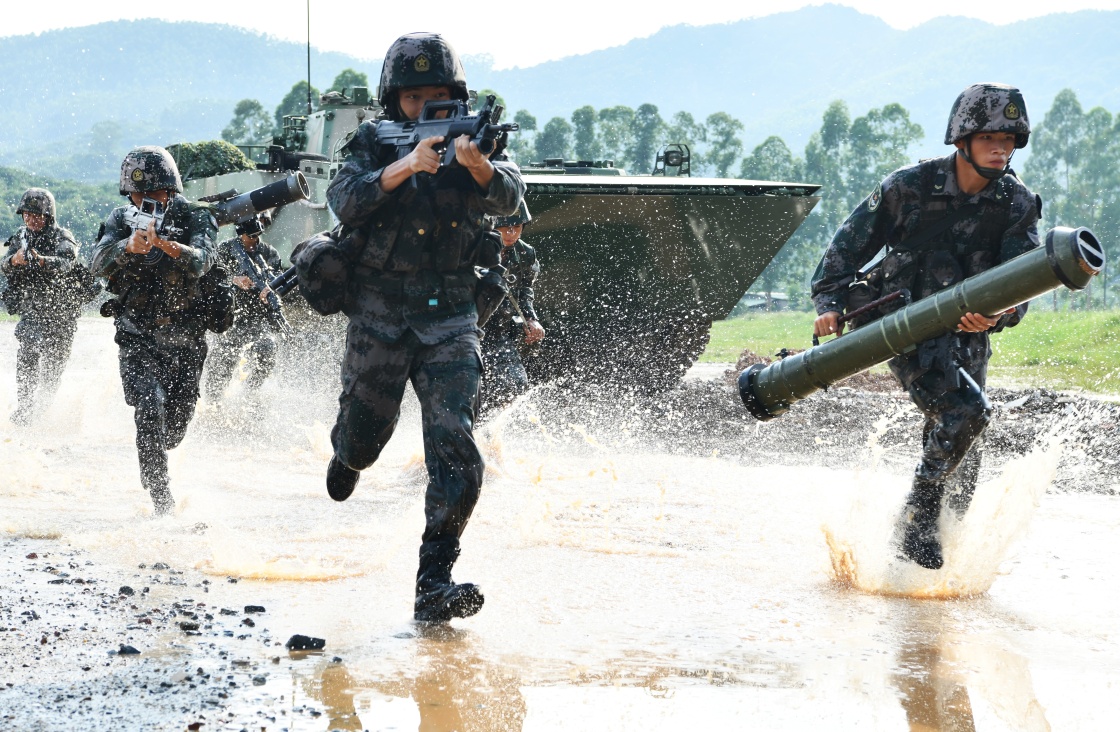
PF-98A of a China Army Amphibious Infantry Squad
Source (here)
I counted a 5-man squad: one PF-98 ammo carrier, one PF-98 launcher, one commander, one LSW and one w/rifle grenade launcher.



Saturday, June 22, 2019
Hi res photos of the day: infantry squad PF98A 120mm anti-tank rocket
Enters PF98A, a lighter, less expensive variant of the PF98, purposely built for infantry squad operations. Main changes are: Tube service life reduced from 500 rounds to just 200 due to thinner material for weight reduction. A single "stick" instead of a bipod/tripod - again - for weight reduction. A fire team of 2 troopers carries only a total of four rockets (2x2) with them, weighting in about 15.33 kg for the entire kit, geared for a greater foot-mobility. The tube by itself weights 22lbs or 10kg without warheads.


No comments:
Post a Comment