This is the blog of China defense, where professional analysts and serious defense enthusiasts share findings on a rising military power.
Saturday, June 24, 2017
Monday, June 19, 2017
Photos of the day: Fancy formation flying
Not sure who the PLAAF is trying to impress here but they just did a fancy formation flying with five J-20, seven J-11 and a bunch AWACs.
Saturday, December 17, 2016
Photos of the day: PLAAF 126th Air Brigade's in-service J-20A, serial numbers 78271 and 78274
Sunday, June 18, 2017
Where is the PLAN?
Currently there are 12 PLAN surface ships dispatching abroad from their home bases (2 DDG, 6 FFG and 4 tankers).
Chinese naval escort taskforce visits New Zealand
http://eng.chinamil.com.cn/view/2017-06/16/content_7642495.htm
Chinese naval fleet visits Iran
http://eng.chinamil.com.cn/view/2017-06/16/content_7642344.htm
Chinese naval fleet visits Pakistan
http://www.china.org.cn/world/2017-06/11/content_41005515.htm
And of course, Gulf of Aden.
Want to join the PLA Navy? To see the world, perhaps fight off a pirate
or two around the Gulf of Aden? Be careful what you wish for you might
end up defending Fairy Bay (神仙湾) in Xinjiang, the highest PLAN outpost, 5100 meters above sea level (here).
Sr Col 赵兴德 Zhao XingDe, commander of the Naval Boarder Defense Regiment.


Chinese naval escort taskforce visits New Zealand
http://eng.chinamil.com.cn/view/2017-06/16/content_7642495.htm
Chinese naval fleet visits Iran
http://eng.chinamil.com.cn/view/2017-06/16/content_7642344.htm
Chinese naval fleet visits Pakistan
http://www.china.org.cn/world/2017-06/11/content_41005515.htm
And of course, Gulf of Aden.
Monday, January 03, 2011
it's not just a job it's an adventure
Sr Col 赵兴德 Zhao XingDe, commander of the Naval Boarder Defense Regiment.


Saturday, June 10, 2017
Professional PLA article of the day: Waiting in the Wings: PLAAF General Yi Xiaoguang
Another good read from Kenneth Allen and Jana Allen. This article will surely shed some light on the recent PLA/PLAAF re-org, especially on how they would put together a “strategic air force”.
To read the article in its entirety, please visit James Town Foundation (here)
Waiting in the Wings: PLAAF General Yi Xiaoguang
To read the article in its entirety, please visit James Town Foundation (here)
Waiting in the Wings: PLAAF General Yi Xiaoguang
By: Kenneth Allen, Jana Allen
June 9, 2017 09:39 AM Age: 1 day
General Yi Xiaoguang (乙晓光) is an experienced pilot and strategic thinker in the Chinese Air Force who is likely to be tapped as its next Commander
Central Military Commission (CMC) Member and People’s Liberation Army (PLA) Air Force (PLAAF) Commander, General Ma Xiaotian (马晓天), will reach his mandatory retirement age later this year and will likely retire in conjunction with the 19th Party Congress. While much of the PLA’s promotion process remains opaque, transition of the top PLAAF leadership may be becoming more predictable. Ma’s most likely successor is General Yi Xiaoguang (乙晓光), who currently serves as a Deputy Chief of the Joint Staff (formerly General Staff) Department. If appointed, Yi would become the 12th Commander of the PLAAF since it was created in November 1949. If recent precedent is followed, he would likely also receive a grade promotion from Theater Command Leader to CMC Member and serve concurrently as the Deputy Secretary of the PLAAF’s Party Standing Committee. [1]
A review of his background and career progression in comparison with previous PLAAF commanders strongly suggests that Yi is the most logical successor to Ma. Yi has extensive operational and leadership experience and professional military education. He has rapidly risen in grade and rank since 2001 and since 2014 has held key positions that qualify him to serve at the next higher grade. Since 2012, he has also been an alternate member of the Chinese Communist Party (CCP) 18th Party Congress. Additionally, it has already been established that top PLAAF leadership are expected to represent the service to foreign counterparts. [2] Yi is well prepared to fill this role. He is a strategic thinker who has published on a range of technology-related issues, and in contrast with most of his peers, he has broad experience representing the PLAAF overseas as well as hosting foreign military delegations in China. While his career has followed a similar trajectory to other top PLAAF leaders, Yi is representative of the generational and educational change that is occurring within the PLAAF and being pushed to help build a “strategic air force”.
General Yi Xiaoguang (乙晓光) is an experienced pilot and strategic thinker
in the Chinese Air Force who is likely to be tapped as its next
Commander
Wednesday, June 07, 2017
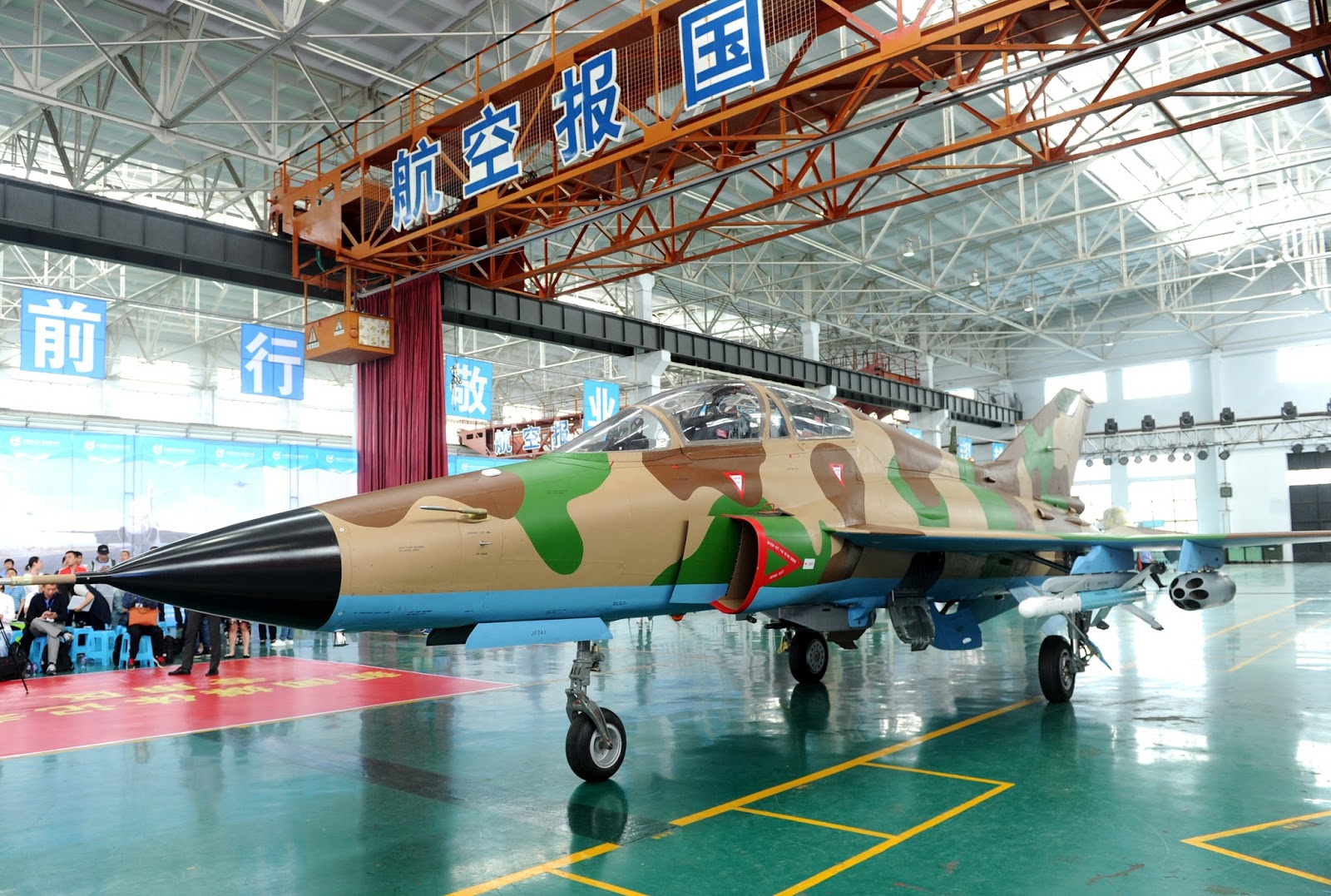
The customer is Sudan, by the way
China's FTC-2000 aircraft export-version rolls off production line
GUIYANG, June 5 (Xinhua) -- The export version of the China-developed light versatile FTC-2000 aircraft rolled off the production line of the state-owned aircraft developer in Anshun in southwest China's Guizhou Province Monday.
With its desert-camouflage paint appearance, the FTC-2000 was developed by the Guizhou Aviation Industry Corporation under the state-owned Aviation Industry Corporation of China (AVIC).
As one of the first batch of its model in the global-military trade market, it will be delivered to overseas clients after necessary procedures and tests, according to AVIC.
The FTC-2000, also named Mountain Eagle, or Shanying in Chinese, is a supersonic advanced fighter trainer. The single-engine light versatile aircraft is a new generation of advanced-fighter trainer designed for advanced training and lead-in fighter training for modern fighters. It is also capable of performing combat missions.
The supersonic aircraft has a mach number of 1.5, and a maximum service ceiling of 16,000 meters.
"It can be used for senior training, elementary combat training and tactical countermeasure training for fighter pilots. And it also has the ability to perform air-to-air and air-to-ground combat," according to Hu Jianxing, deputy manager and chief designer with the AVIC Guizhou Aviation Industry Corporation.
"It completed the 'Stall and Spin Flight Test' within two seconds at the research stage. The FTC-2000 has high safety characteristics," said Hu, adding the model was highly efficient and reliable.
The FTC-2000 maiden flight was on December 13, 2003. And the model has made two public aerobatic flight displays, at the 2006 and 2016 China Airshow in Zhuhai.
In China, the FTC-2000 is the the main advanced trainer used by the PLA Air Force and the PLA Navy.
"The domestic version and export version have the same flying platform. And both are installed with China's home-developed WP-13 turbojet engine, which has been tested for high performance," Hu said. "The export version will be installed with various avionics systems, navigation guidance systems or external stores tailored for overseas client's demand for multiple missions."
Saturday, June 03, 2017
Meet China's latest 50 km/hour amphibious wheeled AFV prototype
This latest North China Institute of Vehicle Research prototype achieved 50km/hour during a calm water speed test.. If verified, it will place it at the forefront of the high speed amphibious expeditionary fighting vehicle race.
The prototype weights in 5.5 tons. Its four wheels can retrace to the chassis at 70 degrees thus reducing resistance during a high speed sprint . This retracing mechanism is controlled via a digital stabilizer integrated into the suspension. Since this is still a prototype/POC, the light armor on its chassis is not unexpected.
What's unknown at this point are its range (land and sea), cruise speed, development status and buoyancy
Monday, June 27, 2016
PR photo of the day: ZTD05 Amphibious Assault Gun on AAAV Chassis in Ramming Speed
But who cares, those "million-man swim" PR photos are the real gem here!
Saturday, June 11, 2016
14th Amphibious Armored Brigade, 31st Group Army, East Theater Command
"Strategic sealift beyond Taiwan is quite limited. China has never possessed a robust capability to transport and land troops under combat conditions" (page 217)
Global Security also chimed in on the sealift question (link here)
First among these limitations is the capability to transport and sustain more than one division of ground troops and equipment by sea or air, according to the US DOD report to Congress on China's military [down from three four decades earlier]. The PLA Navy’s total amphibious lift capacity was estimated in 2009 to be one infantry division of approximately 10,000 troops and equipment at one time.
Or as Patrick Tyler correctly pointed out in his NYT article (link here)
If China has learned anything in decades of conflict with Taiwan, it is that an all-out invasion of Taiwan is well beyond its capabilities. The joke commonly heard among Western military experts is that a Chinese assault on Taiwan would have to be called ''the million man swim.''
To perform this historic "million man swim" the PLA could call up their two Marine Brigades, two Amphibious Mech Infantry Divisions (the 1st of the 1st Group Army, and the 124th of the 42nd Group Army) and every unit of the 1st, 12th, 31st, 41st and 42nd Group Army of the East Theater Command. No worries, they will be dressed up but with no boat to go.
Click on the vid below to see the amphibious assault drill
Friday, June 02, 2017
Newspaper scan of the day: Mobile Landing Platform + Zubr
Tuesday, May 10, 2016
China just launched its 98,000t DWT Mobile Landing Platform (MLP).
Expert: Chinese Navy needs bigger semi-submersible ships for open sea operations
BEIJING, March 28 (ChinaMil) – China needs semi-submersible ships with greater tonnage in the future as the country constantly updates its naval equipment, according to Cao Weidong, a military expert, in an interview with CCTV’s Asia Today.
The
USNS Montford Point, the Mobile Landing Platform (MLP) of the United
States, acted as a mobile offshore port and performed all the material
transfer tasks at sea during the Exercise Ssang Yong 16 concluded on
March 18, a biennial military exercise focused on strengthening the
amphibious landing capabilities of the U.S. and its allies.
Cao
Weidong said in the interview that China has similar equipment known as
semi-submersible ship, but its tonnage is much smaller than that of the
USNS Montford Point.
Cao
said that as China constantly updates its naval equipment,
semi-submersible ships with greater tonnage are needed in the future.
The
Exercise Ssang Yong 16 was held from March 7 to 18, 2016. Yonhap News
Agency reported that the U.S. sent more than 9,200 marines and 3,000
sailors in the exercise while the ROK sent more than 5,000 marines and
sailors. In addition, Australia and New Zealand also sent army soldiers
to the exercise.
In the
exercise, the U.S. first dispatched a large cargo ship loaded with
supplies and logistics equipment to the designated sea area, and then
the USNS Montford Point approached the cargo ship and connected to the
cargo ship with ropes.
Part
of the deck of the USNS Montford Point can be wrapped into the water and
therefore large air-cushioned landing craft can directly reach the deck
of the ship. Then supplies were lifted from the cargo ship to
air-cushioned landing craft and finally transported ashore.
Throughout
the entire process, it can be concluded that with the help of the USNS
Montford Point, the U.S. military will no longer need ports when
transporting heavy equipment and logistics materials from the sea to the
front as the whole transportation work can be completed at sea. That
is, the MLP acts as a mobile offshore port or base at sea.
The
U.S. military officials said that the U.S. military logistics support
can only last 15 days after the landing of its Marines in the past but
now the mobile port provides logistics support for the troops on land at
any time.
U.S.
media disclosed that the U.S. had been brewing the strategic vision of
sea bases at least for one decade, but didn’t find the right equipment.
The construction of the USNS Montford Point started in 2012 and the ship
was delivered to the U.S. military in 2013.
Its
full load displacement is 78,000 tons and the range exceeds 9,000 sea
miles. The U.S. Navy is scheduled to purchase at least two such ships.
Logistics
and equipment support are essential for a force that conducts
operations at open sea. It is undoubtedly a piece of good news if this
supply does not rely on ports.
In
fact, the Chinese Navy has similar equipment. The semi-submersible ship
Donghaidao officially joined the South China Sea Fleet of the PLA Navy
on July 10, 2015. This is China’s first semi-submersible ship.
According
to the website of the Chinese Navy, Donghaidao is a new
semi-submersible ship developed and manufactured independently by China.
The ship is 175.5 meters in length and 32.4 meters in width. Its full
load displacement exceeds 20,000 tons.
The
ship looks similar to the USNS Montford Point and the U.S. has paid
great attention to Donghaidao. The U.S. Navy Institute published an
article on the official website, saying the Donghaidao ship will
significantly improve the amphibious combat capability of the Chinese
Navy.
Cao
Weidong said that China has its own semi-submersible ship and it looks
similar to the USNS Montford Point because they have to perform similar
task, the logistics support.
He
said that China’s semi-submersible ship can transport logistical
supplies and conduct tasks such as maintenance for combat ships and
submarines.
Though
China’s semi-submersible ship is essentially a logistical support base,
its usage is different compared with that of the United States.
First,
China will not send its semi-submersible ship to territories of other
countries. Instead, China’s semi-submersible ship is for the maintenance
and logistics support for its own ships during open sea tasks.
Second,
the tonnage of China’s semi-submersible ship is much smaller than the
USNS Montford Point, in accordance with China’s naval defense needs and
the overall capacity.
Cao
concluded that China needs semi-submersible ships with greater tonnage
in the future as the country constantly updates its naval equipment.
The author is Huang
Zijuan, reporter from the People’s Daily Online. The opinions expressed
here are those of the writer and don't represent views of the China
Military Online website.Saturday, July 04, 2015
Photos of the day: On board PLAN's Mobile Landing Platform (MLP) 868
Subscribe to:
Posts (Atom)