Back on October 10th, I blogged about the PLA Ground Force's amphibious MRL ship LD902 ("L" for Land Force, "D" for East), suggesting that the vessel belongs to the Eastern Theater Command. At the time, there was also a second vessel of a different configuration but similar size operating without visible pennant numbers.
Now, a much sharper set of images has surfaced on the Chinese internet, this time showing LD903, offering our best look yet at this curious class of ships.
The most notable feature is, of course, the rocket armament. The launchers are clearly visible and appear to be arranged in an 8x4 configuration, giving each mount 32 tubes. Multiple launchers can be seen installed on the ship's deck, and the mounts appear capable of traversing left and right as well as elevating to various firing angles.
What remains less clear is whether the launchers can be rapidly reloaded at sea after firing. Likewise, there is still no obvious confirmation of any stabilization system designed to improve firing accuracy while underway. Then again, I'm working from a handful of photos here, not a shipyard tour.
As discussed previously, these launchers are believed to be related to the 122mm navalized multiple rocket launcher system covered here:
The new images also provide a better appreciation of the vessel itself. My rough visual estimate puts it at approximately 70-90 meters in length and perhaps 1,500-3,000 tons displacement. While not particularly large, it is clearly an ocean-going vessel capable of operating well offshore. Assuming the reported 122mm rockets achieve their advertised range, such a ship could potentially provide fire support from as far as 68 nautical miles (126-130 km) east of Fujian, while remaining outside the immediate coastal battlespace.
Interestingly, unlike the U.S. Navy's famous WWII LST(R) rocket ships, LD903 does not appear to be based on a landing ship hull. The vessel lacks the characteristic bow doors and amphibious configuration associated with traditional landing ships. Instead, it looks more like a purpose-built rocket support vessel constructed around a simple commercial-style hull. Judging from the weathering visible in these photos, the ship has likely been in service for some time rather than being a recent launch.
The deck arrangement is particularly revealing. The rocket launchers are mounted on the large open cargo deck aft of the superstructure, suggesting that maximizing salvo size rather than survivability was the primary design goal. There are no obvious signs of sophisticated sensors, expensive combat systems, or elaborate self-defense suites. Defensive armament appears limited to two H/PJ-17 single-barrel 30mm guns, the same weapon commonly found aboard many Chinese auxiliary vessels.
In many respects, this may be the most interesting aspect of the design. The PLA does not appear to be pursuing an exquisite solution here. Instead, it seems to have created a relatively cheap and highly specialized bombardment platform whose sole purpose is delivering large volumes of rocket fire in support of amphibious operations.
That naturally invites comparisons with the U.S. Navy's WWII LST(R)s. Those vessels sacrificed range, precision, and sophistication in exchange for sheer volume of fire. Their job was simple: saturate beaches with rockets immediately before the landing force arrived.
LD903 appears to follow a similar philosophy, updated for the age of long-range guided munitions and modern amphibious warfare. Whether these ships are intended to suppress beach defenses, attack coastal targets, or provide sustained fire support during a Taiwan contingency remains an open question. Nevertheless, the basic concept is familiar: put a lot of rockets on a cheap hull and bring overwhelming firepower to the shoreline.
And that may be the real story here. This is not a glamorous warship. It is not a destroyer, frigate, or amphibious assault ship. It is a specialist tool built for a specific mission.
Given China's enormous commercial shipbuilding capacity, one cannot help but notice that vessels of this type would likely be quick and inexpensive to produce. If the PLA decided it needed dozens of them, the industrial capacity certainly exists to make that happen.


Wednesday, October 14, 2026
122mm Naval MRL for Amphibious Firepower: Back in Service, or Never Bothered to Dismount?
Continuing from the previous discussion on the PLA/NORINCO approach to procurement, particularly the way a successful concept gets replicated, adapted, and squeezed for every possible application, another interesting example recently surfaced. Pun fully intended.
Two photographs circulating on the Chinese internet appear to show a pair of 122mm multiple rocket launchers still mounted aboard a PLA Army Landing Craft Medium (LCM) from the Eastern Theater Command. The vessel itself resembles a downsized version of the Type 073 landing ship medium, but what immediately caught attention was not the hull. It was the rockets.
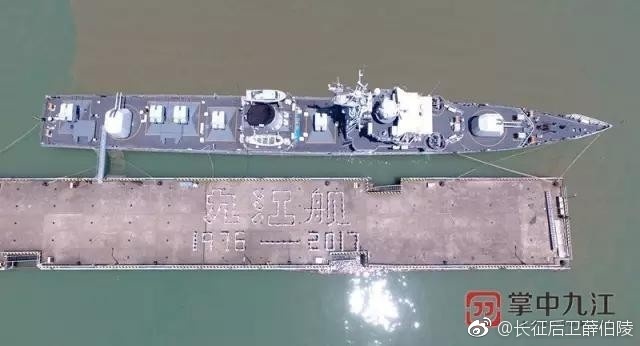
Some readers may remember the considerable online discussion back in the early 2000s when the PLAN mounted five 25-round 122mm multiple rocket launchers on the Type 053H frigate Jiujiang (Hull 516). At the time, the concept struck many observers as unusual, if not outright bizarre.
My view then was largely the same as it is today.
Four launchers carrying a total of 250 rockets sounds impressive until one starts doing the math. Unlike dedicated shore bombardment platforms, there was no rapid reload capability. A 122mm unguided rocket also lacked the accuracy needed for precision strikes, particularly from a relatively small frigate moving in open water. Against hardened defensive positions, saturation and volume of fire matter, and 250 rockets simply did not seem sufficient to justify the effort.
By comparison, the U.S. Navy's WWII-era rocket support ships were built around overwhelming volume. During amphibious operations in the Pacific, particularly Okinawa, an LSM(R) could carry roughly 480 rockets dedicated solely to supporting troops ashore. That is not fire support. That is landscaping on a military scale.
Eventually the online debates faded away. Jiujiang was decommissioned in 2017, and many observers concluded the entire naval MRL experiment had been a one-off curiosity. An interesting chapter, perhaps, but not one with a future.
Fast forward to today, and these newly surfaced images suggest otherwise.
The appearance of 122mm MRLs aboard PLA Army amphibious craft raises an interesting possibility. Perhaps the concept never died at all.
In fact, there is an equally plausible explanation: the PLA Army and the PLAN may have been experimenting with the concept simultaneously all along. While Jiujiang received most of the public attention, the Army side may have quietly continued operating its own rocket-equipped landing craft with little outside notice.
And if that is the case, there is another factor that should surprise absolutely nobody. The PLA is famously reluctant to throw away a solution that still works.
This brings us back to the Bv206-inspired articulated tracked vehicle discussed previously. Once the PLA identifies a concept that proves useful, it tends to expand it across every imaginable role. Ambulance becomes command post. Command post becomes logistics carrier. Logistics carrier becomes something carrying a machine gun. The platform never really retires; it simply acquires another mission.
The same logic may apply here.
A rocket launcher mount already installed on a serviceable landing craft still launches rockets. The hull is still operational. The supporting logistics chain already exists. Why spend money removing a capability that still functions?
To borrow a phrase that has probably appeared on more than one procurement briefing somewhere:
"New equipment costs money. Existing equipment is already paid for."
Viewed through that lens, the continued presence of navalized 122mm MRLs aboard amphibious craft becomes far less surprising. It may not represent a revived capability at all. It may simply be a capability that never went away because nobody could come up with a compelling reason to remove it.
After all, this is the same military culture that sees a useful idea and asks, "How many different jobs can we make this thing do?"
Sometimes the answer is an articulated tracked carrier that ends up doing everything short of filing taxes.
Sometimes the answer is a rocket launcher that remains bolted to a landing craft for two decades because taking it off would require a budget request.
And if there is one lesson from watching PLA procurement over the years, it is this: Never underestimate the lifespan of a capability that is still "good enough" and already paid for.


Tuesday, May 16, 2017
PLAN decommission of the day: FFG516 "Jiujiang" China's only MLR fire-support frigate
Cal: 122mm
No tubes: 50 x 5 (250)
Weight: 5,000kg
Max effective range: 20km
Max range with extended range rocket: 30km
elevation: 0-60 degrees
Field/angle:+- 120 degrees.
Rate of fire: 50 rounds: 18-20 seconds.
Max change rate of elevation: 16 degrees per second.
Max change rate of direction: 16 degrees per second.


No comments:
Post a Comment