Monday, July 13, 2009

Peace Mission 2009 -- PLA Weapons

Looking at the weapons list the PLA is bringing to this exercise, I so want to play Steel Panthers III Brigade Command: 1939-1999 again.

Such display of heavy armor seems somewhat out of place in light of China's current security requirement. To the East is the mountainous terrain of Korea, jungles to the South and yet more mountains to the West and there is an island somewhere. The only tank-suitable terrain is Russia. Oh yeah, I got it, they want to invade Russia with help from the Russians!


Type 89 (YW531) (ZSD89) Command APC


Type86B (WZ501) (ZBD86) IFV


Type 99A (WZ123) (ZTZ99) MBT


PTL02 6x6 Wheeled Self-Propelled 100mm Assaulter


Type 89 (PLZ89) ((WZ/WMZ322) 122mm Self-Propelled Howitzer


WZ-9 Attack Helicopter


WZ-9 Light Attack/Scot Helicopter


Mi-171 Transport Helicopter


Friday, July 10, 2009

PNS Saif

Latest photos of FFG 253 PNS Saif, the last of three sword class FFG to be built in Shanghai


For reference, here is FFG 251 and FFG 252


The Russians are here.

Russian military advanced unit arrives in China for anti-terror exercise:

Judging from equipment on display the PLA "battle-group" assigned to this anti-terror exercise comes from the 115th Mech Infantry Division, 39th Group Army, Shangyang MR and the choppers are members of the 9th LH Regiment, 39th Group Army. It'll be interesting to see what Russia's impression of the Type 99 MBT will be, now that they have a chance to inspect it up close.


Russian military advanced unit arrives in China for anti-terror exercise

english.chinamil.com.cn 2009-07-10

  TAONAN, Jilin Province, July 9 (Xinhua) -- An advance unit of Russia's armed forces arrived at a military base in northeast China's Jilin Province Thursday to prepare for a joint exercise with the People's Liberation Army (PLA).

  The advance unit is headed by Major General Kachan, chief of Russian Far Eastern Military District's air defense forces, and has ten personnel responsible for commanding aviation, parachuting, artillery, communications and logistics units.

  They will make preparations for the 1,300-member Russian troops who will take part in the five-day anti-terrorism military exercise code-named "Peace Mission-2009" to start on July 22.

  The Russian unit was met by Major General Gong Jicheng with the PLA Shenyang Military Command at Jilin's Baicheng train station where they were transported to the PLA's Taonan tactic training base.

  Chinese and Russian defense authorities announced Wednesday that the two nations, both members of the Shanghai Cooperation Organization (SCO), will jointly conduct the exercise.

  Chief of General Staff and General of the Army of the Russian Armed Forces Nikolai Makarov and Chief of the General Staff of the PLA Chen Bingde will hold strategic talks in Russia's Khabarovsk on July 22.

  About 1,300 personnel from the army and air force of each side will participate in the exercise. Russia will also send an airborne assault unit, according to the Defense Ministry.

  Prior to the Russian advance unit, the PLA's director team for the exercise headed by Lieutenant General Ma Xiaotian had arrived at the training base.

  Most of the PLA's 1,300 troops in the exercise have been deployed and are making the final preparations, according to Ma, who is also deputy chief of the PLA's General Staff.

  The Taonan tactic training base is one of the PLA's major bases for military exercises. It belongs to the PLA's Shenyang Military Command which borders Russia's Far Eastern region to the north.

  After the "Peace Mission-2009" joint anti-terror exercise, the military base will be engaged in the "Stride-2009" exercise in August and September, the largest tactic training exercise so far conducted by the PLA.


Wednesday, July 08, 2009

170 Kilometers Southwest of Okinawa

On June 29th, the PLA Daily reported a North Sea Fleet task force conducting a comprehensive military drill under “a complex electromagnetic environment”. (here)


At first I did not pay much attention as the PLAN conducts near shore drills frequently. It turns out that the drill was conducted near the 2nd island chain and 170 Kilometers Southwest of Okinawa. The task force left port on the 19th, “entered” the Pacific Ocean (passed the first island chain) on the 22nd and started the drill on the 25th. Look, they also brought along a tug boat, just in case they needed a tow.

Wow! I am surprised to see no coverage in the West about this minor venture, come to think of it, it is the month of Michael Jackson, so the lack of interest is understandable.


On totally unrelated news… Japan may deploy troops near “disputed” islands in the East China Sea. (here)


Here is a follow from PLAdaily regarding this ex.

The red banner reads "exit the island chain"

http://pic.chinamil.com.cn/news/2009-07/10/content_1831609.htm

“牢记领袖嘱托,忠实履行使命”。6月15日—30日,北海舰队某驱逐舰支队“石家庄”号导弹驱逐舰与兄弟部队舰艇组成联合编队进行远航训练。他们 在复杂海域、复杂电磁环境中结合新大纲对复杂条件下导弹、火炮攻击,支援受损舰、海上拖带等多科目进行实战化训练,有效检验和提高了部队战斗力。 中国军事图片中心 王洪建 特约通讯员 于文献 摄 (责任编辑:孙礼)


Tuesday, July 07, 2009

“Chinese Mine Warfare -- A PLA Navy ‘Assassin’s Mace’ Capability”

“Chinese Mine Warfare -- A PLA Navy ‘Assassin’s Mace’ Capability” by Andrew S. Erickson, Lyle J. Goldstein, and William S. Murray has been published by the US Naval War College’s China Maritime Studies

http://www.nwc.navy.mil/cnws/cmsi/documents/CMS3_Mine%20Warfare.pdf

Mine Warfare is an area of great interest by the PLAN and yet it has been overlooked by many analysts, hopefully this paper will shed new light on the PLAN’s capabilities and intentions. This is the most comprehensive study available on the topic, and is a highly recommended read.

You know these guys do great work, right?


Sunday, July 05, 2009

Mahanian revival in Asia -- a debate

Back in June 13, I was talking to my friends about how much I enjoy the writing style of Banyan, a columnist for The Economist. (Here) While I don't know much about Mahan and his notion as argued by Banyan but I like how he writes and the way he frames his arguments. I would be grateful to Confucius if I can write 10% as well. To support his main argument of a Mahanian revival in Asia, Banyan cited Jim Holmes and Toshi Yoshihara of the United States Naval War College’s and Robert Kaplan’s “Center Stage for the Twenty-first Century” published in the March/April 2009’s issue of Foreign Affairs (here) Being a long time readers of Holmes and Yoshihara’s work, I believe they were somewhat misquoted.

In no time, the real debate started; first Holmes and Yoshihara wrote an indirect response in the current issue of The Jamestown Foundation’s China Brief titled "A Chinese Turn to Mahan?" (here) to “clarified” their view on the Mahanian notion to both Kaplan and “A columnist for The Economist”. In due course , Andrew Erickson and Thomas Culora of Naval War College wrote a rebuttal titled "Arms and Influence at Sea" to Kaplan (here)

A coordinated effort by the USNWC boys? most likely not. Both sides made some good points and I am not educated enough to take sides, but it is always wonderful to see professionals debate in public, I feel like I am getting an education because of it. I am anxious to read Banyan and Kaplan’s response.

Thursday, July 02, 2009

Stupid PLA PR


I know no idea that Gary Larson, creator of Far Side, works for PLA now.


Wednesday, July 01, 2009

The COSCO (China Ocean Shipping Company) “Spirit”

The first “China design and build” Roll-on/Roll-off (RoRo) vehicle carrier launched on June 24, 2009 at Zhoushan shipyard marking a major advance in China’s building capability.


The COSCO (China Ocean Shipping Company) “Spirit” 中远盛世 has a fully loaded displacement of 14,500 tons, capable of carrying 5000 vehicles with a design speed of 20 knots. Its dimensions are: 182.8 meters in length, 32.2 meters in width and 34 meters high. It has a total of 9 stationary and 3 adjustable decks to accommodate vehicles of different heights. Just like other modern RoRo’s, the COSCO Spirit is fully automated and allows for single-crew-piloting.


COSCO cited the increase in automobile imports as the sole reason to build such a fleet and indeed in January, China surpassed the US as the world’s largest car market. (Here) But the RoRo carrier can press into military service and is generally considered a national security asset according to the August 2006 report “The Role of United States’ Commercial Shipping Industry in Military Sealift” presented by the US DOD due to its capability to load and offload large volumes of vehicles in repetition. US civilian RoRo fleets under the US Transportation Command were credited as a necessary strategic asset during the recent gulf war as cited by the same report.


The RoRo carrier also played an important support role for the Royal Navy during the 1982 Falklands War by ferrying 4000 troops to the remote island battlefield. Today one of the Royal Navy’s auxiliary training ships, the HMS Argus, was also converted to a RoRo carrier.


Additional RoRo carriers will augment the PLA’s transport capabilities especially in situations where large numbers of Armored Fighting Vehicles (AFV) are needed. At the same time, one must be careful not to view it as an amphibious asset for operations directed at “a run-a-way island,” err, I mean “an investment partner” as RoRo carriers require a secure and undamaged deep seaport in order to offload.


Photos of COSCO "Spirit" with primer gray and a top deck that can accommodate helicopter operations.
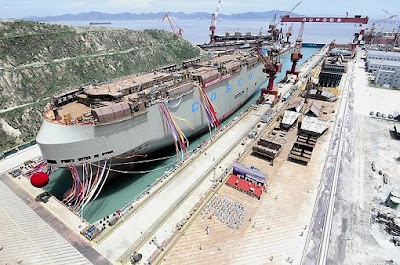
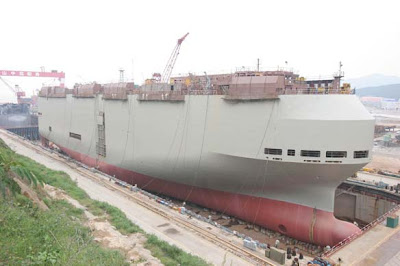


It looks similar to the French Navy's amphibious assault ship Mistral (L9013)


Previous RoRo with imported designs are painted red such as the smaller Changjilong which launched in Sept 08, 2008
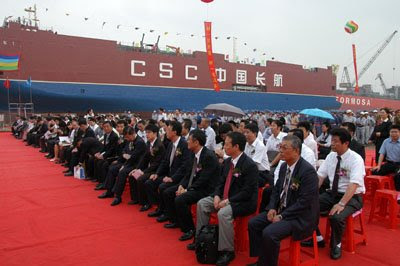
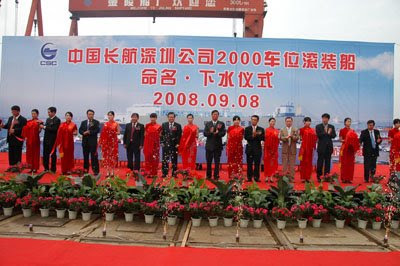


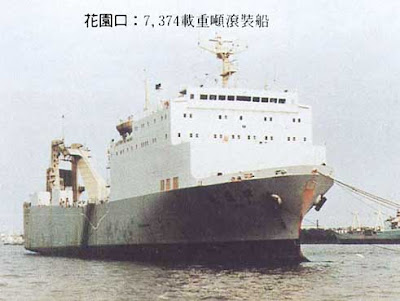
Other RoRo currently in civilian service


CCTV Reported a military exercise involving Yue Hai Tie 2, a railroad car RoRo, pressed into military server in Hainan Island.